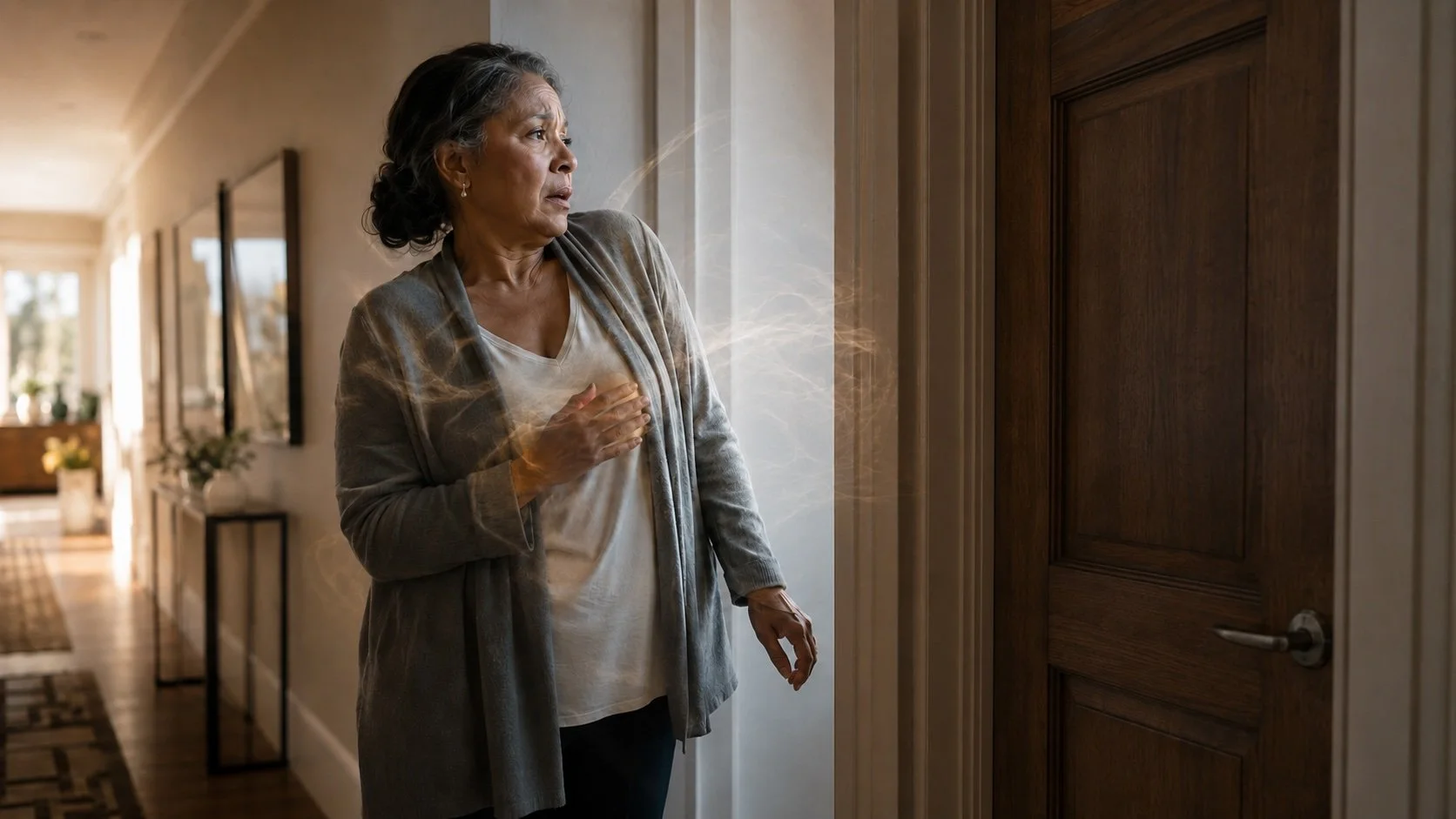
What Remains After the Door Slams? The Energy We Leave Behind
A slammed door ends a moment, but not its energetic impact. Discover how emotional energy, unresolved patterns, and conscious awareness shape every relationship.
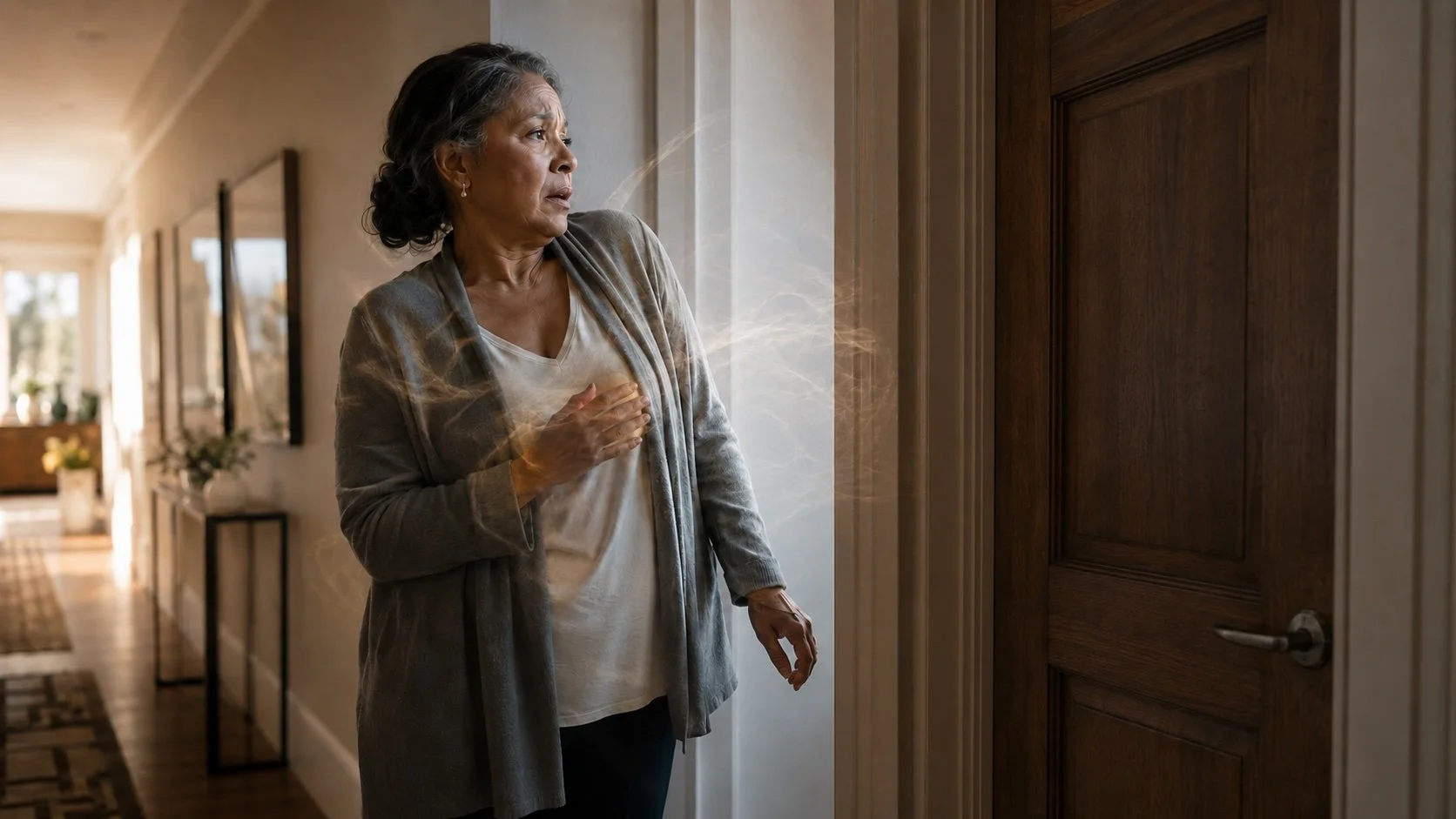
If this question has ever lived in your body, this article found you for a reason.
By Helena Collins, creator of the Apex Life in Synergy® Program
A door slams.
The sound lasts only a second. The physical movement is over almost as soon as it begins. Yet the moment itself may remain suspended in the room, in the body, and between two people long after the door has stopped moving.
One person stands on one side, perhaps shaking, furious, frightened, or suddenly numb. The other walks away, convinced that the interaction has ended. But has it?
At Life in Synergy®, we understand human interaction as more than the exchange of words and visible gestures. Every encounter also carries intention, emotion, attention, and energy. A door slammed in someone’s face is therefore not merely an object being closed. It can become a declaration without language: You are shut out. You do not matter. Your presence is unwanted. I refuse to meet you here.
The person closing the door may not consciously mean all of those things. They may simply be overwhelmed and desperate to escape an interaction. But human beings do not receive one another through intention alone. We also receive impact. The space between what one person intended and what the other person experienced is where many repeating patterns begin.
The body hears the slam
Before the conscious mind has time to explain the event, the body may respond. The shoulders tighten. The jaw locks. Breathing becomes shallow. The heart seems to strike harder against the chest. A person may freeze in place or immediately feel the urge to shout, cry, retaliate, or disappear.
This physical response does not prove weakness or overreaction. The body is responding to sudden sound, motion, conflict, and perceived rejection. It is attempting to determine whether the moment is over or whether something else is coming.
For the person who slammed the door, the body is also involved. Anger does not evaporate merely because a barrier has been placed between two people. The hand that pushed the door may still be tense. The breath may remain shortened. The mind may begin constructing a case for why the action was justified. Beneath that mental argument, however, the body can remain caught inside the unfinished encounter.
This is one reason dramatic exits rarely deliver the freedom they promise. They create distance, but distance is not necessarily resolution. The room changes; the inner state often does not.
The etheric echo of an unfinished moment
Within the spiritual framework of Life in Synergy®, we use the word etheric to describe a subtle energetic dimension of human experience. This is not presented as a medical measurement. It is a way of understanding the felt atmosphere carried by intention, emotion, and unresolved interaction.
Most people have experienced this dimension whether or not they use spiritual language for it. You enter a room after an argument and immediately sense that something happened. A person says, “I’m fine,” yet the space around them feels anything but fine. Someone leaves, but their anger appears to remain behind like heat in the air.
When a door is slammed in another person’s face, the etheric exchange can feel abrupt and violent because the relationship has been severed in motion but not completed in consciousness. The physical door closes; the energetic interaction remains open.
The rejected person may carry the moment forward as humiliation, abandonment, anger, or self-doubt. The person who slammed the door may carry it as righteousness, guilt, fear, or the temporary intoxication of control. Each person may leave with a different story, but both have been altered by the exchange.
If neither person becomes conscious of what happened, the energy seeks another place to go. It may appear later as coldness at dinner, impatience with a child, tension in the neck, sleepless mental rehearsals, or an argument about something apparently unrelated. Unprocessed energy is rarely loyal to its original location. It travels.
This does not mean every uncomfortable feeling is a mystical force, nor does it mean one difficult moment permanently damages an etheric field. It means that what we refuse to meet consciously can continue shaping perception, behavior, and the atmosphere of a relationship.
A boundary and a punishment are not the same thing
There are moments when closing a door is necessary. If an interaction is unsafe, abusive, threatening, or escalating beyond control, creating physical distance may be the wisest and most loving choice available. Spiritual responsibility never requires someone to remain accessible to harm.
But there is a profound difference between closing a door to establish safety and slamming it to inflict pain.
A conscious boundary says, “I cannot continue this interaction right now. I am stepping away.” A punitive gesture says, “I want you to feel my rejection.” Outwardly, the actions may look similar. Energetically, they are not.
The difference lives in intention, awareness, and what happens next. Does the person return when calm and take responsibility for their part? Do they explain the boundary? Do they acknowledge the impact? Or is silence used as a weapon, leaving the other person to wander inside uncertainty?
At Life in Synergy®, we teach that each person is 100% responsible for their 50% of an interaction. This does not mean accepting blame for another person’s behavior. It means refusing to abandon responsibility for the energy, choices, and patterns that belong to us. If you slammed the door, my responsibility is not erased because you were difficult. Consciousness begins when both people stop using the other person’s behavior as permission to remain unconscious.
The pattern beneath the hand
The door is rarely the whole story.
For one person, the slam may be an old pattern of power: When I feel vulnerable, I end the encounter before you can leave me. For another, it may be a pattern of emotional disappearance: When conflict awakens discomfort, I remove myself without explanation. For the person left outside, it may awaken an older wound: Once again, I am the one who is excluded, unheard, or abandoned.
These patterns can meet with extraordinary precision. One person fears being controlled and pushes away. The other fears abandonment and pursues. The pursuit intensifies the first person’s need to escape; the escape intensifies the second person’s need to pursue. Soon, neither is responding only to the present moment. Each is reacting from a history that has entered the room wearing today’s clothes.
This is why simply declaring who was right is often insufficient. Rightness may settle an argument, but it does not necessarily reveal the pattern. The deeper question is not only, “Who slammed the door?” It is, “What became activated in each of us before the door ever moved?”
Returning consciousness to the threshold
Healing does not require pretending the moment was harmless. It asks us to return to the threshold with greater awareness than we possessed when we left it.
Begin with the body. Before composing the perfect apology or defense, stop. Feel your feet. Release the jaw. Allow the exhalation to lengthen naturally. Notice whether the body is preparing to fight a battle that is no longer physically happening. A Return to One practice can help interrupt the momentum—not to suppress anger, but to prevent anger from becoming the only intelligence available.
Then name the act without decoration.
“I slammed the door in your face.”
Not, “I’m sorry, but you made me.” Not, “I only did it because you always...” The moment we attach an accusation to an apology, we quietly return responsibility to the other person.
The next step is to acknowledge impact without insisting that your intention be accepted as the final truth.
“I was overwhelmed and wanted the interaction to stop. I can see that the way I ended it may have felt rejecting and frightening.”
This language does not require self-condemnation. Shame often produces more hiding, more defensiveness, and another slammed door. Responsibility is different. Responsibility stands in the doorway and remains present.
If you were the person left on the other side, your work is equally sacred but different. You are allowed to name what happened. You are allowed to decide what behavior you will not accept. You are also invited to notice what the moment awakened within you. Did the event hurt only because of what happened today, or did it find an older doorway inside you—one that has been slammed many times before?
Recognizing an older wound does not excuse the present behavior. It prevents the present behavior from owning your entire history.
What we leave behind can be changed
No one moves through a lifetime without closing something too quickly. We have all withdrawn, reacted, protected, punished, or mistaken emotional force for personal power. Conscious living is not a performance of perfection. It is the willingness to become aware of the energy we create and to participate in its transformation.
The true aftereffect of a slammed door is not determined only by the slam. It is also determined by what follows.
Does pride guard the threshold? Does silence harden around the event? Do both people continue feeding the story until the moment becomes evidence for every injury they have ever known?
Or does someone become conscious enough to return—not necessarily to reopen the relationship, but to reopen integrity?
An apology can change the energy. A clearly spoken boundary can change it. An honest acknowledgment can change it. Sometimes the most powerful transformation occurs privately, when a person realizes, “I will no longer send my unresolved pain through doors, voices, bodies, or silence.”
That decision matters because energy does not end with the person directly in front of us. The aggression we do not examine can reach the next conversation. The rejection we do not heal can shape the next relationship. The tension held in the body can become the emotional weather of a home.
But consciousness travels too.
One person who stops, breathes, and refuses to pass the wound onward changes the field of what happens next. One person who becomes 100% responsible for their 50% creates a new possibility where repetition once seemed inevitable.
The door may already have slammed.
You cannot retrieve that second from time. But you can decide what energy will cross the next threshold.
If you are ready to understand the recurring patterns beneath your reactions and relationships, explore the Apex Life in Synergy® Program at LifeInSynergy.com. The work is not about becoming someone who never feels anger. It is about becoming conscious enough that anger no longer decides what you leave behind.
Life in Synergy®, founded by Helena Collins and Brian Collins, is dedicated to helping individuals understand recurring life patterns, cultivate inner peace, and develop higher levels of consciousness through multi-award-winning online educational programs. The Apex Life in Synergy® Program, Synergistics Fitness Method®, EFV Keys, and Helena Collins' bestselling Nutritional Alignment® integrate spiritual wellness, behavioral insight, subconscious awareness, and practical personal transformation into one comprehensive educational system. Discover more at https://www.lifeinsynergy.com.

Understanding vs. Knowledge
Many people pursue knowledge but never achieve understanding. Discover how deeper awareness reveals recurring patterns, expands consciousness, and transforms your life through the principles of the Apex Life in Synergy Program®.

If this question has ever lived in your body, this article found you for a reason.
By Helena Collins
Humanity has become obsessed with knowledge.
We celebrate the accumulation of information. We reward credentials, memorization, expertise, and the ability to quickly provide answers. Entire industries have been built around convincing people that the next book, course, certification, or technique will finally provide the missing piece they have been searching for.
Yet despite having access to more information than any generation in history, many people remain trapped in the same repeating cycles of frustration, anxiety, self-doubt, unhealthy relationships, financial struggles, and internal conflict.
Why?
Because knowledge and understanding are not the same thing.
Understanding is an expansion of consciousness. Knowledge is often the assumption that consciousness has arrived.
One remains open.
The other frequently closes the door.
Understanding begins with the acknowledgment that there is always more to discover. It is the recognition that every answer reveals another question and every layer of awareness uncovers deeper dimensions hidden beneath the surface. It is not a destination. It is a relationship with life itself.
Consider something as simple as walking.
Most people know how to walk. They have been doing it for decades. Yet very few people truly understand the patterns being expressed every time they take a step.
Do you favor one side of your body?
Does one foot turn outward more than the other?
Do you lead with confidence or caution?
Do you move quickly through life or hesitate before every step?
Do you carry tension in your shoulders?
Do you hold your breath when stressed?
Now look deeper.
Do your parents move in similar ways?
Do they carry the same physical tendencies?
The same emotional tendencies?
The same fears?
The same relationship patterns?
The same struggles?
At what point does observing a simple gait become the study of consciousness itself?
What appears to be a physical habit may actually reveal inherited patterns expressing themselves through the body. A posture becomes a story. A movement becomes a message. A tendency becomes a blueprint.
The deeper understanding is not found in the act itself.
It is found in what the act reveals.
This principle applies equally to mathematics, science, spirituality, relationships, fitness, business, and every area of human experience. The moment we label one form of understanding as more important than another, we have entered judgment. The observation of your own walk can reveal as much about your existence as years spent studying a textbook if you are willing to look deeply enough.
Everything becomes a teacher when awareness is present.
Knowledge, however, often attempts to place a finish line where none exists.
Knowledge says:
"I know."
Understanding says:
"I am learning."
Knowledge seeks ownership.
Understanding seeks relationship.
Knowledge attempts to define reality.
Understanding recognizes that reality continuously expands beyond definition.
Can any human truly claim complete knowledge of anything?
Do we fully understand consciousness?
Do we fully understand love?
Do we fully understand the human body?
Do we fully understand time?
Do we fully understand the universe?
Every discovery humanity makes opens the door to ten new mysteries. Every answer reveals another layer waiting to be explored.
Yet life continues regardless of our ability to explain it.
The stars move.
The oceans rise and fall.
The heart beats.
The tree grows.
Existence unfolds.
Not because we know.
But because it is.
This is why certainty can become one of the greatest obstacles to growth.
The moment we believe we fully understand something, we stop observing it.
We stop listening.
We stop questioning.
We stop evolving.
The pattern often disguised as knowledge is frequently ego.
Ego seeks ownership over reality. It wants certainty. It wants control. It wants to conquer what can never truly be conquered.
Understanding requires something much more powerful.
Humility.
The humility to recognize that no matter how much we learn, we are still touching only a tiny fraction of an infinite whole.
The humility to understand that wisdom is not measured by how much information we collect.
It is measured by how deeply we are willing to observe.
At Life in Synergy, this principle forms the foundation of transformation.
Many individuals arrive seeking answers to their problems. They want certainty. They want solutions. They want someone to tell them exactly what to do.
What they often discover instead is something far more valuable.
They discover how to observe.
The Apex Life in Synergy Program® was never created to simply provide more information. It was designed to help individuals recognize the hidden patterns operating beneath the surface of their lives. The repeating emotional loops. The inherited tendencies. The recurring life experiences. The subconscious programs that continue expressing themselves until they are understood.
Because transformation does not occur when knowledge is added.
Transformation occurs when understanding deepens.
The moment you stop trying to own reality and begin relating to it, everything changes.
The world becomes less about certainty and more about discovery.
Less about control and more about awareness.
Less about knowing and more about becoming.
And perhaps that is the greatest understanding of all.
PS: This blog is an except of an actual Apex Life in Synergy Module
The work of understanding recurring life patterns has been at the heart of Life in Synergy for decades.
Through the combined work of Helena Collins, creator of the Apex Life in Synergy Program® and the award-winning Synergistics Fitness Method®, and Brian Collins, creator of the EFV Keys (Energetic Frequency Vibrations) System, thousands of individuals have been guided toward greater self-awareness, personal transformation, inner peace, and consciousness development.
Life in Synergy's multi-award-winning online spiritual wellness and personal transformation programs are designed to help individuals identify recurring patterns, uncover subconscious influences, strengthen self-understanding, and create lasting positive change through greater awareness and alignment.
Explore the Apex Life in Synergy Program®, Synergistics Fitness Method®, and additional transformational resources at www.lifeinsynergy.com.

Flowing Into Fall: The Sacred Reminder of Change
Boston’s multi award winning wellness teacher Helena Collins reminds us all that we are a part of nature itself and thus are never disconnected from the ability to step into the rhythm of life itself.

💨
The air is shifting.
The warmth of summer in New England ( Our home base) is giving way to crisp mornings, falling leaves, and the scent of woodsmoke. Nature does not resist. Trees surrender their leaves, animals prepare for the winter, and the Earth tilts without hesitation into the next season of its eternal rhythm. And yet—how often do we humans forget that we are not separate from this cycle, but woven into it?
Autumn is not simply a change in weather; it is a mirror.
It asks us to pause, to breathe, to notice what we have been clinging to that no longer serves us. Just as trees let go of their leaves, we too are called to release what has run its course—habits, doubts, fears, or even identities we’ve outgrown.
🙋🏼♀️
But here’s the question:
Do you flow with change as nature does? Or have you forgotten that humans are part of nature itself?
In a world that constantly shouts for us to stay the same—stay productive, stay distracted, stay in patterns that numb the soul—it’s easy to lose the ability to align with our own natural rhythm. The result? Resistance. And resistance creates stress, stagnation, and a sense that life is something happening to us instead of through us.
At Life in Synergy, we see fall not as the ending of summer but as an invitation to awaken. This season is your teacher. It shows you the beauty of surrender, the necessity of transition, and the truth that everything has its time. When you align with that truth, you remember that change is not to be feared—it is to be honored.
So, we ask you directly:
✨ Is it time to learn how to tune back into the most precious gift—yourself?
Because when you return to yourself, you return to the source.
When you flow with the energy of the season, you remember that you, too, are cyclical, vast, and capable of transformation. This fall, don’t just watch the leaves drop. Feel the shift within you. Let your body, mind, and spirit realign with the rhythm of the Earth. The tools are here, the guidance is here, and the energy is here.
🌊
Your next step is simple: come back into flow with who you really are.
Explore the Apex Life in Synergy Program and rediscover the power of aligning your inner rhythm with the eternal wisdom of nature.

Breaking Free from Negative Patterns:
Negative patterns are behaviors or thought processes that can cause harm or distress to individuals or those around them.
These patterns can be difficult to break, as they are often deeply ingrained habits that have been reinforced over time. In this article, we will explore what negative patterns are, why they matter, and how they can be addressed…….

Understanding the Power of Habit
Negative patterns are behaviors or thought processes that can cause harm or distress to individuals or those around them.
These patterns can be difficult to break, as they are often deeply ingrained habits that have been reinforced over time. In this article, we will explore what negative patterns are, why they matter, and how they can be addressed.
What are negative patterns?
Negative patterns can take many forms, such as compulsive behaviors, negative self-talk, or destructive relationships. They can be caused by a variety of factors, such as trauma, stress, or negative self-image, and can lead to a range of negative outcomes, such as anxiety, depression, or substance abuse.
One of the key characteristics of negative patterns is that they tend to be repetitive and self-reinforcing. Once a pattern has been established, it can be difficult to break out of, as it can become a habit that is reinforced by a sense of familiarity or comfort.
Why do negative patterns matter?
Negative patterns can have a significant impact on an individual's life and can lead to a range of negative outcomes, such as mental health issues, relationship problems, or substance abuse. In addition, negative patterns can be self-perpetuating, leading to a cycle of negative thoughts and behaviors that can be difficult to break.
Moreover, negative patterns can have a ripple effect on those around us, affecting our relationships with family, friends, and coworkers. They can also have an impact on the wider community, as negative patterns can contribute to issues such as crime and social isolation.
How can negative patterns be addressed?
Breaking negative patterns can be a challenging process, but it is possible with the right approach. The first step is to identify the negative pattern and the underlying factors that contribute to it. This may involve seeking support from a mental health professional, such as a therapist or counselor, or engaging in self-reflection and journaling.
Once the pattern and underlying factors have been identified, the next step is to develop a plan for breaking the pattern. This may involve developing new habits or coping strategies that can help to counteract the negative pattern. For example, if the negative pattern involves substance abuse, a plan may involve seeking support from a substance abuse treatment program, developing healthy coping strategies, and building a strong support network.
Finally, breaking negative patterns requires persistence and patience. It can take time to break a deeply ingrained habit, and setbacks may occur along the way. However, with a strong support network and a commitment to change, it is possible to break negative patterns and move towards a more positive and fulfilling life.
Conclusion
Negative patterns can be difficult to break, but they are not insurmountable. By understanding the power of habit and the impact of negative patterns, individuals can develop strategies for breaking free from these patterns and moving towards a more positive and fulfilling life. Whether seeking support from a mental health professional, engaging in self-reflection, or developing healthy coping strategies, breaking negative patterns is a journey that can lead to growth, healing, and a better quality of life.
Let me show you how to break your patterns..
Helena

After us there will be________?
Imagine……

Imagine you were let’s say, Ben Franklin, Frederick Douglass, or how about one of the Wright Brothers.
Could you imagine that your thoughts and actions at the time would lead to so much change in the future?
Far too often we forget that we are shaping reality through our efforts ( both good and bad). We think a closed business deal is a totality, a “great” day is better than a “bad” day or ego-based actions are “what” the world needs ( think penis-shaped rockets or deciding whatever tech social media babble is said is bond).
We want to colonize other planets and yet still haven’t stopped killing and hating each other here on Earth?
Now excuse me for being bold, but what exactly the fuck? Do these tech bro czars realize that they want to move “Earthlings” to Mars but haven’t looked at the concept of taking care of human consciousness BEFORE we do so? You don’t need an MIT or Yale degree to see that transferring a race chock full of racism and hate to another area and thinking that the same thing happened on Earth won’t happen there as well is….
Actual madness if you think about it.
We have computers between our ears, but fail to see that our brain software needs a HUGE update…we still are extensions of a hunter-gatherer mentality that discounts others to “get ours”. How long do you think that a tribe on Mars would last if we brought all our unresolved bullshit to another planet? Imagine if there was an impending disaster that would wipe out Earth and that these ego cock rockets were the arks that would be the last hope for humanity to survive as a race.
How long before the Billionaires realized that THEY had to pick up their own garbage? Clean their own pod? and GASP Treated someone else like their equal? (Insert spooky 1950s horror theme sound here). Yup…it would be the end of humanity and the blip that was humans would indeed be over. So, how about stepping back for a moment and think…hmmmmmm? Could this guy on this website I never heard of actually be correct?
It isn’t hard to see…..we need to ascend internally before we ascend to other planets physically.
Brian and Helena
ps
Our programs to help human consciousness are right here world.