
You Can Love Someone Without Carrying Their Emotional Baggage.
Discover how to stop absorbing other people's emotional baggage, break generational patterns and protect your inner peace through self-awareness, spiritual growth and Helena Collins's Apex Life in Synergy® Program.

By Brian Collins — Co-founder of Life in Synergy®
If this question has ever lived in your body, this article found you for a reason.
As we approach Thanksgiving and the holiday season, millions of people are preparing to gather around tables filled with food, memories, laughter and, unfortunately, emotional baggage that has been passed around for generations like a family heirloom nobody remembers asking for.
It's remarkable how quickly a fully grown, independent, spiritually aware adult can walk through a familiar doorway and suddenly find themselves emotionally responding as the person they were twenty or thirty years ago.
One comment. One facial expression. One familiar tone of voice. Suddenly, you're participating in an old emotional dance you thought you had stopped dancing years ago.
But what if you didn't have to dance and “throw out” your heart n the process?
Love Is Not an Agreement to Suffer Together
Somewhere along the way, many of us learned that loving someone meant carrying their pain, accommodating their anger, absorbing their disappointment and sacrificing our own peace to maintain theirs.
We confuse compassion with emotional obligation. We confuse loyalty with suffering. We sometimes even feel guilty for experiencing happiness when someone we love refuses to experience their own.
But another person's unhappiness does not require your participation in it.
You can sincerely love someone who is angry without becoming angry yourself. You can care about someone who is struggling without making their struggle the central experience of your existence. You can sit beside someone in darkness without extinguishing your own light.
Compassion and self-preservation are not opposing spiritual forces.
The Invisible Shit Suitcase
Imagine that every person you encounter is carrying an invisible suitcase filled with their experiences, disappointments, fears, expectations, unresolved emotions and beliefs about the world.
Some have spent years carefully examining its contents. Others have never opened it. Some spend their lives trying to convince everyone around them to help carry it.
Now imagine how exhausted you might become if, throughout your lifetime, you continually volunteered to carry everyone else's suitcase while neglecting to examine your own.
Many people spend so much time attempting to manage the emotional atmosphere around them that they rarely become acquainted with the atmosphere within them.
And then they wonder why they are exhausted.
This does not mean that we should abandon those we love or refuse to help people in genuine need. It means becoming aware of the distinction between supporting another human being and surrendering our own emotional stability to their internal circumstances.
The Spiritual Responsibility of Your 50%
Within Helena Collins's Apex Life in Synergy® Program exists a powerful principle: giving 100% of your 50%.
Consider the implications of that statement.
How much of your life have you spent attempting to change another person's half of a relationship while overlooking opportunities to evolve within your own?
How many conversations have you rehearsed, arguments have you replayed, and imaginary scenarios have you constructed in an effort to change someone else's perspective?
What might happen if some of that attention were redirected toward your own personal evolution?
This is not about becoming indifferent. It is about becoming conscious.
There is a profound difference between responding to life from a place of awareness and allowing decades of conditioned behavior to dictate your participation in the present moment.
You may not be able to change the emotional history of your family, but you can begin to examine the role you continue to play within it.
You Can Sit at the Same Table Without Sitting Inside the Same Patterns
This Thanksgiving, consider giving yourself something that cannot be purchased during a Black Friday sale: permission to experience your own peace.
When someone makes that familiar comment, observe your reaction before automatically responding. When an old disagreement resurfaces, ask yourself whether participating in it serves any constructive purpose. When guilt appears because you are choosing happiness, examine where that guilt originated.
Pay attention to your physical responses, too. Notice whether your shoulders tighten, your breathing changes or your jaw clenches. Your physical experience may offer valuable clues about your emotional state.
You do not have to announce your personal evolution to the entire dinner table. You do not need to deliver a spiritual dissertation between the mashed potatoes and the pumpkin pie.
Sometimes growth is simply recognizing that you have a choice where you once believed you had none.
Breaking the Cycle Is an Act of Love
Imagine the possibilities if each generation became increasingly conscious of the emotional patterns it was passing to the next.
Perhaps we would inherit fewer grudges and more understanding. Fewer fears and more curiosity. Fewer emotional obligations and more authentic expressions of love.
Personal transformation does not mean erasing your history. It means recognizing that your history does not have to become your permanent identity.
You are allowed to evolve beyond the emotional environment in which you were raised. You are allowed to love people without repeating their patterns. You are allowed to experience joy even when others have not yet discovered theirs.
And perhaps one of the greatest gifts you can offer another human being is the example of someone who has chosen to evolve without demanding that everyone else evolve alongside them.
If This Article Found You...
Perhaps you have spent years carrying emotional baggage that was never yours to begin with. Perhaps you are beginning to recognize patterns that have followed you through relationships, friendships and family gatherings.
Helena Collins created Apex Life in Synergy® to invite individuals into a deeper exploration of themselves mentally, physically and spiritually. Through conscious personal development, the Synergistics Fitness Method®, Nutritional Alignment® and sacred energy exercises, participants are invited to discover a different relationship with themselves and their experience of life.
There is so much more to discover about who you are beyond the roles you have learned to play.
Love deeply. Live consciously. Allow others their journey while honoring your own.
The next time someone offers you their invisible suitcase, remember that you can love the traveler without carrying the luggage.
I choose a Life in Synergy.
The American Psychological Association's November 30, 2023 survey found that 89% of American adults experienced at least one source of holiday stress, while 22% cited actual or anticipated family conflict.
This Thanksgiving, bring a dessert.
Bring your love.
Bring your gratitude.
But for heaven's sake, stop volunteering to carry everyone else's emotional luggage.
You have your own spiritual journey to attend to.

Are You Buying Wellness, or Actually Becoming Well?
Are You Buying Wellness, or Actually Becoming Well?
By Helena and Brian Collins | Life in Synergy®
If this question has ever lived in your body, this article found you for a reason.
How much money have you spent trying to feel better?
Go ahead. Think about it.
The gym memberships. The supplements. The fitness gadgets. The miracle diets. The meditation apps. The books promising to change your life in thirty days.
Maybe you've tried cold plunges, intermittent fasting, juice cleanses, wearable technology, or the latest revolutionary approach to longevity.
And let's not forget the products that promise to turn back the clock.
Apparently, aging has become a personal failure that can be corrected with the proper subscription.
Good grief.

By Helena and Brian Collins | Life in Synergy®
If this question has ever lived in your body, this article found you for a reason.
How much money have you spent trying to feel better?
Go ahead. Think about it.
The gym memberships. The supplements. The fitness gadgets. The miracle diets. The meditation apps. The books promising to change your life in thirty days.
Maybe you've tried cold plunges, intermittent fasting, juice cleanses, wearable technology, or the latest revolutionary approach to longevity.
And let's not forget the products that promise to turn back the clock.
Apparently, aging has become a personal failure that can be corrected with the proper subscription.
Good grief.
Now, don't misunderstand me.
There are wonderful innovations in health and wellness. Scientific discoveries have improved countless lives, and new technologies can provide valuable information about our bodies.
But after decades working in the wellness industry, Helena and I have noticed something extraordinary.
The trends keep changing. The human being remains remarkably consistent.
People still want to feel loved.
They still struggle with their relationships.
They still search for meaning.
They still experience fear, frustration, joy, insecurity, and hope.
They still want to feel comfortable in their bodies.
And perhaps most importantly, they still want to understand why their lives unfold the way they do.
So here's a question worth asking.
Are we actually becoming well, or have we simply become very good at buying wellness?
We've Watched the Wellness World Reinvent Itself Again and Again…We've never needed to become the next big thing. We've been busy doing the work.
When you've spent decades working directly with people, you develop an interesting perspective.
You begin to recognize patterns.
Not just in the people you work with, but in the industry surrounding them.
Helena and I have watched wellness trends arrive with enormous excitement.
We've seen exercise philosophies rise to prominence, only to be replaced by the next revolutionary approach.
We've watched nutritional advice swing from one extreme to another.
We've seen products, programs, and personalities promise extraordinary transformations.
Something becomes the answer.
Everybody talks about it.
Everybody wants it.
Then, seemingly overnight, something new arrives.
And the previous miracle quietly disappears.
We've watched this cycle repeat itself throughout our careers.
But here's what I find fascinating.
The fundamental questions people bring to us haven't disappeared with those trends.
Why do I keep making the same choices?
Why do I struggle to love myself?
Why am I unhappy when my life looks successful?
Why do I keep repeating the same relationship patterns?
Why does my body feel disconnected from the way I want to live?
Why can't I find peace?
These aren't fashionable questions.
They're human questions.
And no matter how sophisticated the wellness marketplace becomes, those questions deserve more than another temporary answer.
Our Methods Were Never Built Around a Trend
In 1996, Helena Collins created the Synergistics Fitness Method®.
Not because the wellness industry needed another exercise fad.
And not because she wanted to attach a fashionable name to something everyone else was already doing.
Helena developed SFM from her own understanding of conscious movement, physical participation, and the relationship between the individual and the body.
That was thirty years ago.
Think about how many fitness trends have appeared, disappeared, and reappeared under different names since then.
Yet SFM remains part of the work we share today.
Over the years, our Life in Synergy® philosophy has continued to guide our approach to personal growth, movement, nourishment, and self-awareness.
And while the way we deliver our teachings has evolved, the principles at their foundation have remained consistent.
Not because we refuse to learn something new.
Quite the opposite.
We've spent decades observing, questioning, challenging, and refining our understanding.
But we have never believed that something becomes more valuable simply because it's fashionable.
A principle doesn't become obsolete because someone invents a new marketing campaign.
And something doesn't become true just because it's trending.
The Wellness Industry Has Become an Enormous Marketplace
According to McKinsey's November 2026 Future of Wellness report, the global wellness market is estimated at $2.7 trillion under the categories included in its analysis.
Two out of three surveyed American consumers said they prioritize wellness more than they did a year earlier.
The report also describes growing interest in wearable technology, biological testing, recovery experiences, and approaches to optimizing physical performance.
That's an extraordinary amount of attention devoted to feeling better.
And much of that interest is understandable.
People want healthier lives.
They want energy.
They want mobility.
They want to age well.
They want to feel good about themselves.
But the size of a marketplace doesn't tell us whether the people participating in it have developed a meaningful relationship with themselves.
Purchasing a product is an action.
Understanding yourself is a process.
And those two things are not interchangeable.
You Can Own Every Wellness Product and Still Be Unhappy
Imagine someone with the perfect wellness routine.
They track their sleep.
Monitor their heart rate.
Count their steps.
Measure their protein.
Schedule their workouts.
Take their supplements.
They've got more information about their physical activity than previous generations could have imagined.
Wonderful.
But now ask them something different.
Are you happy?
Do you respect yourself?
Do you understand your emotional reactions?
Can you communicate honestly with someone you love?
Do you recognize when you're repeating a behavior that no longer serves you?
Are you comfortable spending time alone with your own thoughts?
Do you know what gives your life meaning?
Suddenly, the numbers on the smartwatch don't seem quite so comprehensive.
That's not a criticism of technology.
It's a recognition of its limitations.
A device can measure aspects of your physical activity.
It cannot decide what makes your life meaningful.
A supplement may address a particular nutritional need.
It cannot teach you how to respect yourself.
An exercise program may help develop physical capabilities.
It cannot automatically resolve a relationship you've spent twenty years avoiding.
Wellness information is not the same thing as personal understanding.
And possessing information doesn't guarantee that we know how to apply it.
The Difference Between Buying a Solution and Participating in One
This is where Life in Synergy® has always taken a different approach.
We don't believe personal growth is something that simply happens to you because you've purchased a product or enrolled in a program.
You have to participate.
You have to become willing to examine yourself.
Your thoughts.
Your beliefs.
Your expectations.
Your behaviors.
Your physical experiences.
Your relationships.
And yes, sometimes that means confronting things you've spent years avoiding.
There's a principle at the heart of our teachings.
You are responsible for 100% of your 50%.
Not everyone else's half.
Not every circumstance in the world.
Not every outcome you cannot control.
Your half.
Your participation.
Your choices.
Your willingness to become aware.
And that is something no wellness gadget can do for you.
A product may support your efforts.
A teacher may offer guidance.
A program may provide knowledge and structure.
But the actual experience of living your life?
That belongs to you.
The Truth Doesn't Need a New Name Every Six Months
Let's talk about something that makes the wellness industry uncomfortable.
Not everything needs to be reinvented.
Sometimes the most important principles are also the least fashionable.
Learning to recognize your behavior.
Understanding how your choices affect your experiences.
Developing a respectful relationship with your body.
Becoming aware of how you communicate.
Recognizing your responsibilities without attempting to control everyone else.
Learning to participate consciously in your own life.
None of these ideas requires a celebrity endorsement.
They don't need an expensive device.
They don't become irrelevant because a new trend appears on social media.
And they certainly don't need a dramatic new name every six months.
That doesn't mean our teachings are beyond questioning.
Far from it.
We believe meaningful understanding should welcome examination.
Experience should be questioned.
Assumptions should be challenged.
New knowledge should be considered.
And claims about physical or psychological health should be evaluated according to the evidence supporting them.
But there is a difference between remaining open to discovery and constantly abandoning your foundation to chase the next fashionable promise.
The truth of your own experience is something you must be willing to examine, not something another person can sell you in a bottle.
Thirty Years Later, We're Still Here
When Helena created SFM in 1996, neither of us could have predicted every change the wellness industry would experience.
We couldn't have imagined all the technology that would eventually become part of everyday life.
Or the enormous marketplace that would grow around people's desire to feel healthier, happier, and younger.
But we knew something important.
A person is more than a collection of physical measurements.
More than a body to be reshaped.
More than a mind to be distracted.
More than a consumer searching for the next solution.
A human being is an extraordinary combination of physical experience, awareness, relationships, choices, and the ongoing process of living.
That understanding has continued to shape our work.
Over the decades, we've had the privilege of working with thousands of people.
We've watched individuals challenge long-held beliefs, explore unfamiliar possibilities, and begin recognizing aspects of themselves they had previously overlooked.
We've also learned that no teacher can do another person's work for them.
No program can guarantee a particular transformation.
And no amount of experience gives anyone ownership over another person's truth.
What we can do is share what we've learned.
Offer the methods we've developed.
Invite people to explore their own experiences.
And continue standing behind the principles that have guided our work through decades of changing wellness trends.
We've never needed to become the next big thing. We've been busy doing the work.
Wellness Isn't Something You Collect
Perhaps it's time to rethink what wellness actually means.
Not as a competition.
Not as a shopping list.
Not as a collection of expensive routines designed to demonstrate how seriously you take your health.
But as an ongoing relationship with yourself.
How you nourish your body.
How you move.
How you respond to life's challenges.
How you treat yourself and others.
How you recognize your own participation in the experiences unfolding around you.
This doesn't mean abandoning medicine, scientific research, or useful innovations.
It means recognizing that no single product, practice, or philosophy can replace the full complexity of being human.
You can appreciate new discoveries without chasing every trend.
You can use technology without allowing it to define your worth.
You can pursue physical wellbeing without turning your body into an endless improvement project.
And you can seek guidance without surrendering responsibility for your own choices.
Perhaps that's where meaningful personal growth begins.
Not with the question, "What should I buy next?"
But with something much more personal.
What am I willing to understand about myself today?’
If This Article Found You...
Maybe you've tried everything.
Every new routine.
Every promising program.
Every supplement that sounded convincing.
Every wellness trend that promised this time would be different.
And perhaps some of those experiences genuinely helped you.
Wonderful.
But if you're still searching, consider this possibility.
Maybe the next step isn't another product.
Maybe it's a different relationship with yourself.
Helena and I have spent decades sharing a philosophy that has continued through an extraordinary number of changes in the wellness world.
We've watched trends come and go.
We've watched yesterday's revolutionary idea become tomorrow's forgotten product.
And through it all, we've continued returning to the same essential understanding.
You cannot purchase your participation in your own life.
You have to live it.
You have to experience it.
You have to become willing to recognize the choices, beliefs, and behaviors that shape your journey.
That's why Helena created Apex Life in Synergy®.
To bring together the teachings and methods developed through our decades of work into an educational journey that invites you to explore your life more consciously.
Not as another passing wellness trend.
Not as a miracle cure.
And certainly not as a promise that someone else will transform your life for you.
But as an invitation to discover what becomes possible when you begin participating more fully in your own existence.
The wellness industry will continue changing.
There will always be another trend.
Another breakthrough.
Another product promising to be the answer.
Some innovations will prove genuinely valuable.
Others will eventually fade away.
But long after the advertisements disappear, one relationship will remain.
The relationship you have with yourself.
And that relationship deserves your attention.
Trends come and go. Your life is happening now.
I choose a Life in Synergy.
Discover the Difference Experience Makes
For decades, Helena and Brian Collins have shared the Life in Synergy® philosophy, bringing together personal growth, conscious movement, and greater self-awareness.
Created by Helena Collins in 1996, the Synergistics Fitness Method® remains a foundational part of their approach.
Today, the Apex Life in Synergy® Program makes these teachings available through an online educational journey you can explore at your own pace.
If you're tired of chasing the next wellness trend and are ready to explore a more meaningful relationship with yourself, we invite you to discover what Life in Synergy® has to offer.

When Did Rest Become Something You Have to Earn?
Maybe it's the first time you've stopped moving all day.
The dishes are done. The emails have been answered. The errands are finished. You've taken care of everyone and everything that needed your attention.
And for one glorious moment, there is absolutely nothing you have to do.
Then it happens.
That little voice.
Shouldn't you be doing something?…….

Rest is not a reward for everything you've accomplished. It is part of living a Life in Synergy®.
By Brian and Helena Collins | Life in Synergy®
If this question has ever lived in your body, this article found you for a reason.
You finally sit down….
Maybe it's the first time you've stopped moving all day.
The dishes are done. The emails have been answered. The errands are finished. You've taken care of everyone and everything that needed your attention.
And for one glorious moment, there is absolutely nothing you have to do.
Then it happens.
That little voice.
Shouldn't you be doing something?
You look around.
There's probably laundry somewhere. Something needs organizing. A phone call could be made. Tomorrow's responsibilities are already lining up, patiently waiting for their turn to consume your attention.
And suddenly, sitting quietly feels almost irresponsible.
Interesting, isn't it?
You can work yourself into exhaustion and feel accomplished.
But sit peacefully for twenty minutes and somehow feel guilty.
When did rest become something you have to earn?
And perhaps the more important question is, who convinced you that you weren't already worthy of it?
The Invisible Scoreboard
Somewhere along the journey of being human, many of us begin keeping score.
Not necessarily on paper.
It's an internal scoreboard.
How much did I accomplish today?
Was I productive enough?
Did I do everything expected of me?
Did I make everyone happy?
Did I contribute enough to justify taking time for myself?
And when the answers don't satisfy us, we keep going.
One more task.
One more responsibility.
One more opportunity to prove that we're doing our part.
But here's where things become fascinating.
Who is actually keeping score?
Is it your employer?
Your family?
Your partner?
Society?
Or have you become so accustomed to measuring yourself through productivity that you no longer need anyone else to demand it?
You've become your own supervisor.
And apparently, your supervisor doesn't believe in lunch breaks.
When Being Busy Becomes Your Identity
There is nothing inherently wrong with working hard.
Creating something meaningful, caring for people we love, building a business, raising a family, and contributing to the world can bring tremendous satisfaction.
But something changes when what we do becomes the primary measure of who we are.
We stop saying, "I accomplished something today."
And begin believing, "I am valuable because I accomplished something today."
Those are two very different statements.
One describes an experience.
The other assigns a condition to your worth.
And once your worth becomes conditional, rest can begin to feel threatening.
Because if you're not producing, achieving, helping, fixing, or accomplishing something, what exactly are you contributing?
Perhaps you've never asked yourself that question directly.
But your behavior may have been answering it for years.
You apologize for taking a day off.
You explain why you deserve a vacation.
You feel uncomfortable when someone else is working and you're not.
You describe a quiet afternoon as having "done nothing," as though experiencing your own life somehow doesn't count.
And the most extraordinary part?
You might even be proud of how little rest you need.
Until your body begins having a very different opinion.
Your Body Doesn't Understand Your Need to Prove Yourself
Your body participates in every moment of your existence.
It doesn't clock out when you finish working.
It doesn't stop responding to your experiences simply because you've decided to ignore them.
Physical and psychological demands can affect sleep, attention, mood, and the way we experience everyday life.
Rest and recovery are not rewards reserved for people who have completed enough tasks.
They are ordinary human needs.
Yet we sometimes treat our bodies as though they exist solely to carry out the demands of our minds.
Keep going.
Push harder.
Don't complain.
There's too much to do.
And when the body becomes tired, uncomfortable, or overwhelmed, we may interpret its signals as inconveniences.
As though our physical experience is interrupting the important business of living.
But consider this.
Your body is not an obstacle standing between you and your life. Your body is part of the life you're experiencing.
At Life in Synergy®, this relationship between conscious awareness and physical participation is central to Helena Collins's Synergistics Fitness Method®.
Movement is not simply something you perform to reach a number or satisfy an external expectation.
It can also become an opportunity to notice yourself.
To recognize how you're moving.
To experience your physical presence.
To become more conscious of the relationship between what you're asking of your body and what you're actually experiencing.
And sometimes, that awareness may include recognizing when it's appropriate to stop.
The Guilt We Carry Into Stillness
Research continues to examine the complicated relationship between workplace burnout, emotional experiences, and guilt.
A 2026 study involving employees across four countries explored how guilt relates to the emotional experience of burnout.
The findings add to a broader conversation about how emotional patterns and demanding environments can interact.
They don't establish that guilt causes burnout, or that changing your thoughts alone will resolve exhaustion.
But they do raise a question worth exploring.
Why can doing something necessary for our wellbeing feel emotionally uncomfortable?
Why might a person recognize that they're exhausted and still struggle to give themselves permission to rest?
For some, the answer may involve practical circumstances.
Financial pressures.
Caregiving responsibilities.
Demanding workplaces.
A household that simply doesn't have enough help.
Those realities matter.
Not everyone has the freedom to rearrange their life whenever they need a break.
But sometimes there is another layer.
An internal belief that says:
If I'm resting, someone else is carrying the load.
If I say no, I'm being selfish.
If I stop, I'll fall behind.
If I'm not useful, I'm not enough.
And those beliefs deserve our attention.
Because even when an opportunity for rest finally arrives, they can make it difficult to experience.
Are You Responsible for Everything, or Just Your Part?
At Life in Synergy®, we return to a principle that can change the way we understand personal responsibility.
You are responsible for 100% of your 50%.
That doesn't mean doing half of everything.
It means taking full responsibility for your participation without assuming ownership of everything outside your control.
You can care deeply about your family without being responsible for everyone else's happiness.
You can love your work without being available every moment of the day.
You can support someone without sacrificing every personal need.
You can give generously without making exhaustion the evidence of your generosity.
And you can recognize that other people have their own participation, responsibilities, and choices.
This isn't an invitation to abandon your commitments.
It's an invitation to understand them.
Because there's a profound difference between responsibility and the belief that you must personally hold the entire world together.
One can give your life meaning.
The other can leave you feeling that your life belongs to everyone but you.
And perhaps the greatest irony is that the person demanding the most from you may sometimes be the one looking back from the mirror.
When Peace Feels Uncomfortable
Have you ever noticed how uncomfortable quiet can feel?
Not because anything is wrong.
But because nothing is demanding your attention.
There is no emergency.
No immediate problem.
No one asking for something.
No task requiring your response.
And instead of enjoying the moment, you begin searching for something to occupy it.
Maybe you reach for your phone.
Turn on the television.
Start cleaning something that was already clean.
Or mentally rehearse tomorrow's obligations.
Anything to avoid the unfamiliar experience of simply being.
We often assume that peace will feel wonderful the moment it arrives.
But if you've spent years responding to constant demands, a quieter moment may initially feel unfamiliar.
That doesn't mean peace is wrong for you.
It may mean you've become accustomed to a different rhythm.
And recognizing that rhythm is an opportunity for awareness.
Not judgment.
Not punishment.
Awareness.
You Are Not a Human To-Do List
Think about someone you genuinely love.
Perhaps your spouse.
Your child.
A dear friend.
Someone who has been part of your life for decades.
Now imagine they came to you completely exhausted.
They've been working hard, caring for others, and doing their best to manage life's demands.
They tell you they feel guilty about taking an afternoon to themselves.
Would you look at them and say:
"Well, have you finished absolutely everything? Because until you have, you haven't earned the right to sit down."
Of course not.
You would probably encourage them to take care of themselves.
You might remind them that they matter beyond what they accomplish.
You might even offer to help.
So why is it sometimes so difficult to extend that same understanding to ourselves?
Why can we recognize another person's humanity while reducing our own to a list of obligations?
You are not a human to-do list.
You are a living, experiencing, evolving human being.
And your existence has meaning beyond your productivity.
Rest Is Not the Opposite of Participation
Here's where I think we've misunderstood something important.
We often divide life into two categories.
Doing something.
And doing nothing.
Working is doing something.
Exercising is doing something.
Helping someone is doing something.
But sitting peacefully?
Watching the trees move in the wind?
Listening to music without multitasking?
Enjoying a conversation without checking the time?
Apparently, those things don't count.
Really?
Who made that rule?
When you are consciously experiencing a moment of quiet, you are still participating in your life.
You are noticing.
Feeling.
Observing.
Experiencing.
You don't have to turn every moment into a project for that moment to matter.
And you don't have to manufacture an achievement to justify enjoying your own existence.
Perhaps one of the most meaningful changes we can make is to stop treating rest as the absence of life and begin recognizing it as part of life.
What Would Happen If You Stopped Keeping Score?
Imagine sitting down this evening without mentally reviewing everything you failed to accomplish.
Imagine enjoying a quiet moment without explaining why you deserve it.
Imagine recognizing your responsibilities without allowing them to define your entire identity.
Imagine being able to say:
"I did what I reasonably could today."
And allowing that to be enough.
Not because you've stopped caring.
Not because you've abandoned your ambitions.
But because you've begun recognizing the difference between meaningful effort and endless self-demands.
Perhaps tomorrow you'll accomplish something extraordinary.
Perhaps tomorrow will be difficult.
Perhaps you'll discover that something needs to change in how your responsibilities are shared.
And perhaps you'll simply experience a perfectly ordinary day.
All of those experiences belong to a human life.
Not just the productive ones.
If This Article Found You...
I'd like you to consider something.
The next time you sit down and that familiar voice whispers, Shouldn't you be doing something?
Don't immediately argue with it.
Don't criticize yourself for having the thought.
Just become aware of it.
Ask yourself:
Who taught me that I have to accomplish something before I'm allowed to experience peace?
And then consider another possibility.
What if you didn't have to earn your right to be present in your own life?
What if your worth wasn't something you had to continually demonstrate?
What if taking responsibility for yourself included recognizing your own needs, rather than endlessly postponing them?
Helena Collins created Apex Life in Synergy® to invite people into a deeper exploration of their relationship with themselves.
Their thoughts.
Their habits.
Their physical experiences.
Their choices.
And the patterns that may have quietly shaped their lives for years.
It isn't about promising a life without responsibilities, challenges, or uncomfortable experiences.
It's about becoming more conscious of how you participate in the life you already have.
Because there is a difference between being alive and spending your entire existence proving that you've earned the right to live.
And perhaps today, your most meaningful accomplishment won't be another task crossed off a list.
Perhaps it will be allowing yourself a moment of peace.
Without apology.
Without explanation.
Without guilt.
You don't have to earn your place in your own life.
You already belong here.
I choose a Life in Synergy.
Discover Life in Synergy®
If this article has you questioning the expectations and habits that shape your everyday experiences, Helena Collins's Apex Life in Synergy® Program offers an opportunity to explore them more deeply.
Through personal-growth education, conscious movement with the Synergistics Fitness Method®, and self-awareness practices, Apex invites you to develop a more intentional relationship with yourself and your life.
Explore the Apex Life in Synergy® Program

The Illusion of Forever: When We Mistake What Is for What Must Always Be
Forever.
What an extraordinary word for a species that lives in a universe where absolutely everything is in motion.
And yet, we humans love that word.
We attach it to relationships, careers, political movements, financial circumstances, personal identities, and even our suffering.
We convince ourselves that because something has been a certain way for a very long time, it must somehow be destined to remain that way.
We confuse familiarity with permanence.
And sometimes, without even realizing it, we build an entire existence around that illusion.
Then something happens that reminds us just how fragile our concept of forever really is……

By Brian Collins | Life in Synergy®
If this question has ever lived in your body, this article found you for a reason.
Forever.
What an extraordinary word for a species that lives in a universe where absolutely everything is in motion.
And yet, we humans love that word.
We attach it to relationships, careers, political movements, financial circumstances, personal identities, and even our suffering.
We convince ourselves that because something has been a certain way for a very long time, it must somehow be destined to remain that way.
We confuse familiarity with permanence.
And sometimes, without even realizing it, we build an entire existence around that illusion.
Then something happens that reminds us just how fragile our concept of forever really is.
A Blue Wave and a Lesson Beyond Politics
This past week, the political landscape in Washington, D.C., experienced a dramatic shift.
The 2026 midterm elections delivered what many have called a blue wave, with Democrats winning control of both chambers of Congress and making significant gains in places that had long been considered reliably Republican.
For some Americans, the results brought celebration. For others, disappointment, uncertainty, or concern.
But step outside the political arena for a moment.
Forget the red jerseys and the blue jerseys.
Something much more interesting just happened.
Political assumptions that had seemed almost immovable were challenged by millions of individual decisions.
Places where people had grown accustomed to one outcome experienced another.
And suddenly, the word forever looked a little less convincing.
This is not a celebration of one political party over another. Political power changes hands, and no party possesses a permanent claim to the future.
It is an observation about the nature of change itself.
What appears permanent may simply be something that has not yet encountered the conditions necessary for transformation.
Now imagine applying that realization to your own life.
The Most Dangerous Prison Has No Walls
How many people remain in relationships that stopped nourishing them years ago because they believe things will never change?
How many wake up each morning already anticipating the same anxiety, the same frustration, the same emotional exhaustion?
How many have convinced themselves that their childhood experiences, family history, past mistakes, or circumstances have permanently determined who they are?
Perhaps you've heard yourself say:
"This is just the way I am."
"Nothing ever works out for me."
"My family has always been this way."
"I've tried everything."
"People never change."
Really?
Never?
That's an awfully long time to be making predictions about a universe that hasn't finished unfolding.
The tragedy isn't simply that people experience difficult circumstances.
Difficulty is part of being human.
The tragedy occurs when we begin identifying so completely with those circumstances that we can no longer imagine ourselves existing differently.
We stop experiencing a temporary condition and begin wearing it as a permanent identity.
The prison door may be unlocked, but we've become so accustomed to the room that we no longer think to turn the handle.
Your Past Is Evidence of Where You've Been, Not a Contract for Where You're Going
One of the most important distinctions we explore through Life in Synergy® is the difference between recognizing a pattern and surrendering your future to it.
Patterns are real.
Our repeated thoughts, emotional responses, learned behaviors, and physical habits influence how we experience our lives.
The human nervous system learns through experience. Repeated responses can become familiar and increasingly automatic.
But familiar does not mean inevitable.
Neuroplasticity, the brain's capacity to change through learning and experience, reminds us that our responses are not necessarily fixed for life.
That doesn't mean transformation is instantaneous or that every circumstance is within our control.
It means the person you have been is not necessarily the only person you are capable of becoming.
And there is an enormous difference between those two beliefs.
One closes a door.
The other invites you to discover what's on the other side.
The Energy We Invest in Keeping Things the Same
Here's something worth considering.
Change doesn't always frighten us because the future might be worse.
Sometimes change frightens us because the future might require us to reconsider everything we believed about the past.
Think about that.
If you've spent twenty years believing you're incapable of happiness, what happens when you begin discovering that happiness may actually be possible?
If you've built your identity around being the person who always sacrifices, always struggles, or always gets hurt, who might you become without that familiar story?
If you've spent decades defending a belief, can you allow yourself to question it without feeling that you're betraying who you are?
These are not small questions.
They reach into the foundations of our identities.
And they reveal something fascinating about the human experience.
Sometimes we invest more energy in defending the permanence of our limitations than in exploring the possibility of moving beyond them.
Not because we're foolish.
Because familiarity can feel safer than uncertainty.
Even when familiarity hurts.
The Difference Between Acceptance and Resignation
There is a profound difference between accepting what is happening in your life and deciding that what is happening must continue forever.
Acceptance recognizes reality.
Resignation declares the future already decided.
Acceptance says, "This is where I am."
Resignation says, "This is where I will always be."
One creates an opportunity for awareness.
The other can quietly extinguish possibility.
At Life in Synergy®, we believe personal transformation begins with developing a deeper awareness of how we participate in our own experiences.
That does not mean blaming ourselves for everything that happens.
We cannot control other people's decisions, political outcomes, economic conditions, illness, or every unexpected event life places before us.
But we can begin examining our responses, our choices, our habitual reactions, and the energy we devote to circumstances we cannot control.
This is where our principle of being responsible for 100% of your 50% becomes so important.
You do not own the entire world.
You own your participation in it.
And that participation matters.
Nothing Lasts Forever. Including the Things You Wish Would.
There's another side to this conversation.
We often think of impermanence as something frightening.
The loss of youth. The ending of relationships. The passing of opportunities. The changing of circumstances.
But impermanence is also what makes growth possible.
Imagine a world where nothing could change.
Where every mistake remained permanent.
Where every painful experience became an unalterable condition.
Where every belief, every social structure, every relationship dynamic, and every emotional response was frozen in place.
Would that really be security?
Or would it be a universe without possibility?
The same principle that allows something beautiful to end also allows something painful to evolve.
The same movement that changes political power can change the circumstances of a community.
And the same capacity for learning and adaptation that has shaped human existence can help us discover new ways of participating in our individual lives.
Not everything changes in the way we want.
Not every problem disappears.
But the possibility of change is inseparable from the experience of being alive.
Perhaps the Question Isn't Whether Things Can Change
Perhaps the more meaningful question is:
What part of your life have you already declared permanent without ever questioning whether that declaration is true?
Is it your relationship with your body?
Your ability to experience peace?
Your understanding of love?
Your relationship with money?
Your belief about aging?
Your sense of self-worth?
Your capacity to forgive?
Or perhaps it's that quiet voice that has followed you for years, insisting that the life you want is somehow reserved for other people.
What if that voice isn't telling you the truth?
What if it's simply repeating something you learned long ago?
And what if you could begin learning something different?
You don't have to overthrow your entire existence tomorrow.
You don't have to deny your history.
You don't even have to know exactly what your future will look like.
You can begin by questioning one assumption.
One belief.
One reaction.
One familiar limitation.
Because transformation doesn't always announce itself with a dramatic revolution.
Sometimes it begins with the simple realization that you no longer have to agree with a story you've been telling yourself for decades.
If This Article Found You...
Perhaps you've been waiting for something outside yourself to change before giving yourself permission to live differently.
A relationship.
A job.
An economy.
An election.
A person.
A circumstance.
And perhaps the events unfolding in Washington this week offer a reminder that even deeply established systems can change.
But you don't have to wait for the world to reorganize itself before beginning to explore your own possibilities.
For decades, Helena Collins has devoted her work to helping people examine the patterns, behaviors, and relationships between mind and body that shape their everyday experiences.
Through the Apex Life in Synergy® Program, she invites you into an educational journey of self-discovery, awareness, movement, and personal responsibility.
Not to promise you a perfect life.
Not to convince you that you can control everything.
But to help you explore how much of your life may still be open to discovery.
Because the most extraordinary thing about being human isn't that we can make something last forever.
It's that we can continue to grow, learn, and become.
Forever is a powerful promise. But it can become a terrible prison.
And sometimes, the greatest freedom begins the moment you realize that the walls you believed were permanent may not have to define the rest of your life.
I choose a Life in Synergy.
Discover Life in Synergy®
Explore Helena Collins's multi-award-winning educational programs, including Apex Life in Synergy®, Synergistics Fitness Method®, Nutritional Alignment®, and my EFV Keys—Energy, Frequency, and Vibration system of connection.
Your journey toward greater self-awareness and a more fulfilling life can begin today.

Ohm’s Law and the Spirituality of Resistance: When the Energy Within Us Meets the Forces Around Us
At first glance, it seems like a subject better suited for an electrical engineer than someone exploring consciousness, personal transformation, or the deeper meaning of life.But sometimes the greatest insights are hiding in the simplest principles.
And sometimes science offers us a metaphor so profound that it invites us to look at ourselves, our relationships, and the invisible influences shaping our lives in an entirely different way. What if the energy we spend trying to become more powerful would be better spent understanding what prevents us from expressing the power we already possess?

By Helena and Brian Collins | Life in Synergy®
If this question has ever lived in your body, this article found you for a reason.
There is a fascinating principle in physics called Ohm’s Law. It describes something remarkably simple: the relationship between electrical potential, the flow of current, and resistance.
At first glance, it seems like a subject better suited for an electrical engineer than someone exploring consciousness, personal transformation, or the deeper meaning of life.But sometimes the greatest insights are hiding in the simplest principles.
And sometimes science offers us a metaphor so profound that it invites us to look at ourselves, our relationships, and the invisible influences shaping our lives in an entirely different way. What if the energy we spend trying to become more powerful would be better spent understanding what prevents us from expressing the power we already possess?
What if resistance, rather than a lack of potential, is one of the greatest obstacles to living a Life in Synergy?
The Invisible Relationship Between Energy and Resistance
Ohm’s Law establishes that electrical current is determined by voltage divided by resistance.
In simple terms, when voltage remains constant, increasing resistance reduces the flow of current.
Now imagine this principle as a metaphor for human consciousness.
Consider voltage as the potential within you. The capacity to create, to love, to understand, to transform, and to evolve.
Consider current as the expression of that potential through your thoughts, emotions, decisions, relationships, and actions.
And consider resistance as everything that interferes with your ability to express yourself authentically.
Fear. Doubt. Resentment. Conditioning. Unresolved experiences. Expectations. The need for approval. The belief that you must become something other than who you are before you deserve to experience peace.
Suddenly, a principle of electricity becomes an invitation to examine the human experience.
We spend enormous amounts of energy trying to increase our potential without considering the resistance through which that potential must travel.
We seek more motivation, more knowledge, more affirmation, more spiritual experiences, and more reassurance that we are moving in the right direction.
Yet the question remains:
What happens when the resistance within our lives continues to increase while we keep demanding more energy from ourselves?
Eventually, something begins to feel strained.
Not necessarily because our potential has diminished, but because the relationship between our potential and our resistance has become increasingly difficult to navigate.
Not All Resistance Begins Within Us
This is where the conversation becomes particularly interesting.
We often hear that our limitations are entirely self-created. That every obstacle originates in our thinking, and that changing our thoughts will somehow change everything around us.
There is value in recognizing our responsibility for our internal world.
But there is also a difference between taking responsibility for our lives and assuming responsibility for every influence that enters them.
Human beings do not develop in isolation.
From our earliest experiences, we are exposed to ideas about who we should become, what we should believe, how we should behave, and which parts of ourselves are acceptable.
Some of these influences provide guidance, protection, and wisdom.
Others, however, can gradually introduce resistance into a life that once moved with a much greater sense of freedom.
A repeated suggestion can become a belief.
A judgment can become self-doubt.
An expectation can become an obligation.
And an obligation, repeated often enough, can begin to feel like an unquestionable part of our identity.
Sometimes the most influential limitations are not those imposed through obvious force.
They are the ones we eventually learn to impose upon ourselves without remembering where they originated.
We begin questioning our instincts, dismissing our perceptions, and seeking permission to trust what we already know about our own experiences.
And perhaps the most remarkable aspect of this process is how quietly it can happen.
A person may spend years attempting to overcome an internal obstacle without realizing that part of the obstacle was introduced through the expectations, fears, or beliefs of someone else.
This is not about blaming others for the direction of our lives.
It is about developing the awareness necessary to distinguish between what genuinely belongs to us and what we have unconsciously accepted along the way.
Taking responsibility for your life does not require accepting someone else's interpretation of who you are.
When Resistance Becomes Familiar
There is something curious about the human relationship with discomfort.
We can become so accustomed to resistance that its absence feels unfamiliar.
Someone who has spent years anticipating criticism may find themselves uncomfortable when nobody is criticizing them.
Someone who has learned to associate love with obligation may feel uneasy when affection is offered freely.
Someone who has repeatedly been told to question their own judgment may struggle to make a decision without consulting another person.
The resistance has become familiar.
And familiarity, even when uncomfortable, can be mistaken for safety.
This is one reason recurring patterns can be so difficult to recognize.
We may believe we are responding to the circumstances directly in front of us when, in fact, we are responding through the accumulated influence of experiences that occurred long before.
The past has become an invisible participant in the present.
Yet familiarity does not make a pattern permanent.
Awareness gives us the opportunity to examine the beliefs and responses we have carried, determine whether they continue to serve us, and consciously choose something different.
That is where transformation begins.
The Spiritual Significance of Energy, Frequency, and Vibration
Throughout history, spiritual traditions have explored the concept of a vital force expressed through life.
Chi in Chinese philosophy. Prana in Indian traditions. Ki in Japanese thought. Mana in Polynesian traditions.
Although these concepts emerge from different cultural and philosophical understandings, each invites contemplation of the relationship between life, vitality, and the unseen dimensions of human experience.
Within Life in Synergy®, we explore Energy, Frequency, and Vibration through our EFV Keys teachings as a framework for greater awareness and personal alignment.
Ohm’s Law offers an intriguing analogy for this exploration.
Electrical energy behaves according to measurable physical principles. Human consciousness, however, involves biological, psychological, emotional, and experiential processes that cannot simply be reduced to an electrical equation.
The connection is metaphorical, but the reflection can be powerful.
If we consider our personal energy as the capacity to engage with life, then the patterns we repeatedly express influence how that capacity is experienced.
Thoughts influence emotions.
Emotions can influence behavior.
Behavior shapes relationships.
Relationships influence our environment.
And our environment can reinforce the very patterns through which we interpret ourselves.
The cycle continues until awareness introduces a different possibility.
The objective is not to eliminate every uncomfortable thought or emotion.
It is to recognize when a familiar pattern is directing our behavior without our conscious participation.
Awareness is the moment we recognize that a pattern exists. Conscious choice is the moment we begin changing our relationship with it.
The Difference Between Resistance and Resonance
There is another concept worth exploring: resonance.
In physics, resonance occurs when a system responds strongly to stimulation at or near one of its natural frequencies.
Spiritually, we can borrow the idea as a metaphor for alignment.
Think about the moments when your thoughts, feelings, intentions, and actions seem to move together rather than compete against one another.
You are not struggling to convince yourself of something you do not believe.
You are not exhausting yourself attempting to maintain an identity that feels foreign.
You are not constantly adjusting your inner world to satisfy the expectations of everyone around you.
There is a sense of coherence.
A sense that your actions reflect your understanding.
That your choices reflect your values.
That your life is becoming a more authentic expression of who you are.
This is what we mean when we speak about living in synergy.
Not a life without challenges.
Not a life without disagreement.
And certainly not a life in which every circumstance bends to our desires.
Rather, a life in which we become increasingly conscious of how we participate in our own experiences.
The difference between resistance and resonance, in this spiritual analogy, is not simply whether life feels easy or difficult.
It is whether we are acting from awareness or repeatedly reacting through conditioning.
The Heat We Generate When We Fight Ourselves
Electrical resistance can produce heat.
And while emotional stress is not governed by Ohm’s Law, the comparison raises an interesting question.
How much of our daily exhaustion comes from the internal struggle between what we genuinely feel and what we believe we are supposed to feel?
Consider the energy required to maintain an appearance of happiness while experiencing sadness.
To agree outwardly while disagreeing inwardly.
To continually explain ourselves to people who have already decided what they believe about us.
To suppress an intuition because acknowledging it might require an uncomfortable decision.
These contradictions can become exhausting.
Over time, we may begin searching for relief without recognizing that the internal conflict itself deserves our attention.
We try to relax while continuing to participate in the very patterns that disturb our peace.
We seek clarity while repeatedly dismissing our own observations.
We search for freedom while remaining attached to the approval of those who may never understand our choices.
Perhaps the solution is not always to push harder.
Perhaps it begins with recognizing where our energy is being consumed.
And perhaps the most important question is not, "How do I become stronger?"
But rather:
"What am I continuing to carry that no longer belongs in the life I am choosing to create?"
Resistance Is Not Always the Enemy
Here is where we must be careful not to oversimplify the metaphor.
In an electrical system, resistance is not inherently negative. It can be essential for controlling current and allowing components to function safely.
The same distinction is valuable in human life.
Not every boundary is a blockage.
Not every disagreement is dysfunction.
Not every refusal represents fear.
Sometimes saying no is an expression of extraordinary clarity.
Sometimes questioning an accepted belief is the beginning of genuine understanding.
Sometimes the resistance we experience is not evidence that something within us needs to be corrected.
It may be a signal that something around us deserves closer examination.
Spiritual growth should never require abandoning discernment.
Nor should personal transformation become an endless exercise in accepting every outside judgment as a revelation about ourselves.
There is a profound difference between remaining open to learning and surrendering our capacity to think independently.
Healthy resistance protects our integrity.
Unconscious resistance can restrict our growth.
Learning to recognize the difference is an essential part of developing self-awareness.
Your 100% of Your 50%
At Life in Synergy®, one of our foundational teachings is the importance of giving 100% of your 50%.
This principle becomes especially meaningful when examining the relationship between personal energy and resistance.
In every relationship, interaction, and shared experience, there are elements within our responsibility and elements that belong to others.
We can take responsibility for our thoughts, actions, choices, and willingness to grow.
We cannot assume responsibility for another person's consciousness, behavior, or interpretation of reality.
When we attempt to control what belongs to someone else, we introduce unnecessary struggle into our lives.
When we allow others to define what belongs within our own responsibility, we can lose sight of our personal authority.
Giving 100% of your 50% is not about doing half the work.
It is about bringing your full awareness and integrity to the part of life that is genuinely yours.
It means recognizing that another person's opinion does not automatically become your truth.
It means understanding that compassion does not require self-abandonment.
And it means accepting that we can love, support, and understand others without surrendering responsibility for the direction of our own lives.
This is not selfishness.
It is conscious participation.
Becoming the Conscious Conductor of Your Life
For decades, Helena Collins has explored the relationship between physical awareness, personal transformation, and the patterns through which individuals experience their lives.
Her creation of the Synergistics Fitness Method® in 1996 reflects an important aspect of this philosophy: the value of becoming conscious of how we engage our bodies rather than simply moving through familiar motions.
That same principle extends beyond physical movement.
Within our Apex Life in Synergy® Program, Nutritional Alignment® teachings, and EFV Keys, we invite individuals to examine the relationship between their physical, emotional, mental, and spiritual experiences.
The intention is not to provide another rigid set of beliefs that people must adopt.
It is to encourage the awareness necessary to examine their existing beliefs for themselves.
Because genuine personal transformation cannot be reduced to following someone else's instructions indefinitely.
At some point, knowledge must become understanding.
Understanding must become awareness.
And awareness must become conscious participation in everyday life.
We are not suggesting that every challenge can be overcome simply by changing our thoughts. Life is far more complex than that.
But we are suggesting that recognizing our patterns, questioning inherited assumptions, and developing greater self-awareness can change how we respond to the circumstances we encounter.
And that can change the direction of a life.
The Power Was Never the Problem
Return for a moment to Ohm’s Law.
Imagine a circuit with tremendous electrical potential but substantial resistance.
Increasing the voltage may increase the current, but it does not necessarily address the underlying characteristics of the circuit.
Now consider how often we approach our own lives in a similar manner.
We demand greater effort.
Greater determination.
Greater discipline.
Greater spiritual commitment.
We convince ourselves that if we could only become more powerful, more enlightened, or more deserving, everything would finally fall into place.
Yet sometimes the more meaningful work is not about adding something new.
It is about examining what has accumulated.
The assumptions we never questioned.
The expectations we never consciously accepted.
The emotional patterns we continue to repeat.
The beliefs that quietly influence our decisions.
And the subtle ways we may have learned to measure ourselves through someone else's understanding of our worth.
We do not need to reject every influence or challenge every relationship to reclaim our personal authority.
We need to become aware enough to recognize which influences encourage our growth and which ones repeatedly lead us away from our own understanding.
You do not have to fight every current that moves through your life. But you do have the right to determine which direction you choose to travel.
Perhaps that is one of the most beautiful lessons we can draw from this simple principle of physics.
Not that human consciousness is an electrical circuit.
Not that spiritual evolution can be calculated with a mathematical equation.
But that potential, expression, and resistance are worthy of our attention.
And sometimes, in the pursuit of becoming something greater, we discover that the most meaningful transformation begins by questioning what has been standing between us and the authentic expression of who we already are.
That is the journey toward a Life in Synergy.
And it begins with awareness.
If This Article Found You...
Perhaps there is something in your life that has required more effort than it should.
Perhaps you have been trying to change a familiar pattern without understanding why it continues to return.
Or perhaps you have begun questioning whether some of the limitations you have accepted truly originated within you.
You do not need to answer every question today.
Begin by observing.
Notice when you feel aligned with your choices and when you feel compelled to abandon them.
Notice the difference between guidance that expands your understanding and influence that diminishes your confidence in your own judgment.
And remember that personal responsibility does not mean carrying everything that has ever been placed upon you.
At Life in Synergy®, our multi-award-winning educational programs, including the Apex Life in Synergy® Program, Synergistics Fitness Method®, EFV Keys, and Nutritional Alignment®, offer opportunities to explore greater self-awareness, personal growth, and a more conscious relationship with everyday life.
Because the journey is not about becoming who someone else believes you should be.
It is about discovering how to participate more consciously in the life that is yours to live.
I choose a Life in Synergy.
Discover more at www.lifeinsynergy.com.

The Synergistics Fitness Method® : The Method Helena Collins Builtin 1996 When Traditional Fitness Wasn't Enough
Why isn't my body working together?
That question sits at the heart of the Synergistics Fitness Method®.
Created by Helena Collins in 1996, the Synergistics Fitness Method® grew from an idea that was remarkably ahead of its time: instead of simply pushing the body harder, what if we taught the body to work more intelligently as an interconnected whole?
Long before wellness became an algorithm, before social media turned exercise into entertainment, and before “mind-body connection,” functional movement, and integrated wellness became everyday industry language, Helena was working directly with people and observing what their bodies were actually doing.
Real bodies.
Real limitations.
Real imbalances.
Real pain.
And real frustration…..
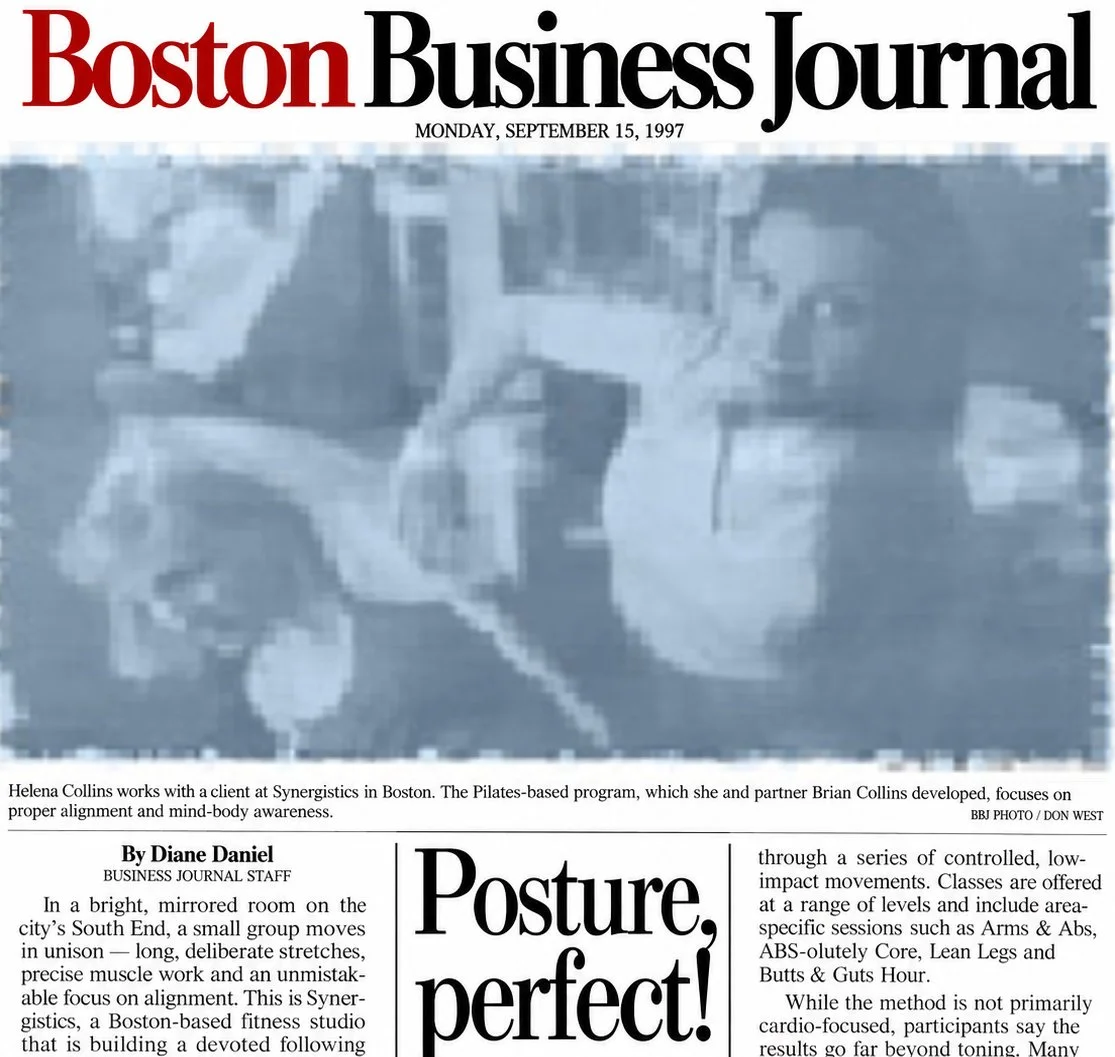
By Helena Collins, Creator of the Synergistics Fitness Method® and Apex Life in Synergy® Program
If this question has ever lived in your body, this article found you for a reason.
There comes a point when you have to stop asking your body to work harder and start asking a much more intelligent question:
Why isn't my body working together?
That question sits at the heart of the Synergistics Fitness Method®.
Created by Helena Collins in 1996, the Synergistics Fitness Method® grew from an idea that was remarkably ahead of its time: instead of simply pushing the body harder, what if we taught the body to work more intelligently as an interconnected whole?
Long before wellness became an algorithm, before social media turned exercise into entertainment, and before “mind-body connection,” functional movement, and integrated wellness became everyday industry language, Helena was working directly with people and observing what their bodies were actually doing.
Real bodies.
Real limitations.
Real imbalances.
Real pain.
And real frustration.
Helena saw something that would ultimately change the direction of her work.
People were exercising, sometimes relentlessly, but exercising more wasn't necessarily creating better bodies.
Strong muscles were getting stronger.
Dominant muscles were continuing to dominate.
Underutilized muscles could remain largely asleep.
Movement patterns were being repeated simply because people had been taught that repetition, intensity, sweat and suffering were evidence of an effective workout.
Helena began questioning the entire equation.
What if the answer wasn't working harder?
What if the answer was learning to work intelligently?
In 1996, Helena turned those observations into what became the Synergistics Fitness Method®—her own proprietary approach to movement, muscular balance and conscious physical awareness.
Helena Collins Didn't Set Out to Create Another Fitness Trend
SFM wasn't born in a corporate conference room.
It wasn't created to capitalize on whatever workout happened to be fashionable that year.
It was created by Helena Collins in 1996, through her own experience with the body and her observations of how people moved, compensated, strengthened and struggled.
Helena had experienced the frustration herself: working out intensely while dealing with physical issues and not getting the intelligent, balanced result she wanted.
Instead of accepting that as normal, she started investigating.
Why were certain muscles constantly doing the work?
Why did other muscles seem almost disconnected from movement?
Why could someone appear physically strong while still lacking balance or stability?
Why were people repeatedly hammering the same muscles while barely communicating with others?
And perhaps most importantly:
Why were we treating the human body like a collection of unrelated parts instead of one interconnected system?
Helena's answer was Synergistics.
Not isolation for isolation's sake.
Integration.
What Is the Synergistics Fitness Method®?
The Synergistics Fitness Method® (SFM), created by Helena Collins in 1996, is a proprietary low-impact movement methodology designed to help create greater muscular balance by consciously engaging underutilized muscles, addressing overused areas, improving stabilization and developing greater awareness of how the body actually moves.
It uses controlled, precise movement rather than mindless repetition.
That distinction matters.
Because SFM isn't simply concerned with whether you can complete an exercise.
It asks:
What is actually doing the exercise?
That's an entirely different conversation with the body.
If the strongest muscle continually takes over a movement, simply performing more repetitions can reinforce the imbalance you're trying to correct.
SFM brings awareness into that equation.
Movement becomes something you experience rather than merely execute.
You begin noticing where tension originates.
Which muscles immediately take control.
Which muscles aren't participating.
Where stability disappears.
Where compensation occurs.
Where movement feels restricted.
And eventually something rather beautiful happens.
You stop merely exercising your body.
You begin learning its language.
No, SFM Is Not Pilates
Let's clear this one up.
The Synergistics Fitness Method® is not Pilates.
Over the years, some journalists compared aspects of SFM's controlled, precise movements with Pilates because they needed an existing fitness vocabulary through which to describe something unfamiliar.
The comparison is understandable.
But the distinction matters.
Helena developed SFM as her own methodology.
Its philosophy, sequencing, muscular emphasis and larger concept of physical synergy came from Helena's observations, experience and work with clients.
SFM wasn't created by asking:
How can we make another version of Pilates?
It emerged from a completely different question:
How can we teach the entire body to work more intelligently together?
That question became the foundation.
The Forgotten Muscles
Here's where SFM becomes fascinating.
Most people naturally gravitate toward movements they perform well.
And the body is incredibly clever.
Give it a task and it will find a way to accomplish it.
Unfortunately, accomplishing the movement doesn't necessarily mean accomplishing it optimally.
Dominant muscles can compensate for weaker ones.
One side of the body can quietly work harder than the other.
Large muscle groups can overpower smaller stabilizing muscles.
And because the movement still happens, we assume everything is fine.
SFM challenges that assumption.
Sometimes the muscle that needs the most attention is precisely the muscle you've barely noticed.
That is why Helena's method became known for deliberately working areas that traditional routines often overlooked.
The movements can sometimes appear deceptively small.
Then you actually do them.
And suddenly some little muscle you apparently haven't spoken to since the Clinton administration introduces itself rather loudly.
Hello. I've been here the whole damn time.
That moment is pure SFM.
Because awareness has arrived.
Small Movement Doesn't Mean Small Work
Modern fitness has trained people to associate effectiveness with spectacle.
Sweat harder.
Jump higher.
Lift heavier.
Move faster.
Collapse dramatically onto the floor afterward so everyone knows something important happened.
SFM takes another path.
A movement doesn't need to be enormous to create meaningful muscular engagement.
Sometimes reducing the movement actually makes cheating more difficult.
Momentum disappears.
Compensation becomes easier to recognize.
Attention increases.
The participant has to remain present.
And presence changes exercise.
You're no longer simply counting repetitions.
You're feeling where the movement originates.
That is the difference between moving your body and understanding your body.
Workout Smart, Not Hard
One of the principles associated with Helena's work from the early days was beautifully simple:
Workout smart, not hard.
That didn't mean SFM was easy.
Anyone who actually experienced one of Helena's classes in Boston could probably have a good laugh at that suggestion.
Smart doesn't mean effortless.
Smart means purposeful.
Every movement should have a reason.
Every position should have intention.
Every repetition should communicate something to the body.
The goal isn't punishment.
The goal is progress.
And there's an enormous difference between the two.
Before Wellness Became a Buzzword
The Synergistics Fitness Method® was created in 1996, long before today's explosion of integrated wellness language and long before many of the concepts now common in the wellness industry became fashionable.
Helena and Brian Collins operated their Life in Synergy studios in Boston, where Helena taught SFM to thousands of people over decades.
The method developed a devoted following because people weren't merely being instructed to exercise.
They were being taught to pay attention.
To their posture.
Their movement.
Their breathing.
Their strength.
Their limitations.
Their patterns.
Their bodies.
And Helena began recognizing something even larger.
The patterns people demonstrated physically often didn't exist in isolation.
Human beings compensate.
We compensate physically.
We compensate emotionally.
We compensate behaviorally.
We compensate in relationships.
We compensate when we're afraid.
We compensate when we don't believe we're strong enough.
And sometimes we compensate for so long that the compensation begins feeling normal.
Sound familiar?
That realization would eventually help Helena's work expand far beyond physical fitness.
The Body Was Teaching a Bigger Lesson
This is where the history of SFM connects directly with what Life in Synergy® has become today.
The body provided Helena with a laboratory for understanding human patterns.
A person might unconsciously allow one muscle to dominate a movement while another barely participates.
Look closely enough at human behavior and something remarkably similar can happen emotionally.
One person overfunctions.
Another withdraws.
One partner carries everything.
Another avoids responsibility.
One part of ourselves becomes enormously developed while another remains neglected.
Different arena.
Same underlying principle:
Imbalance eventually asks to be corrected.
The body taught Helena something profound.
Awareness changes patterns.
And that realization became part of the larger foundation from which the Apex Life in Synergy® Program would eventually grow.
From Physical Alignment to Life Alignment
Today, Helena's work reaches beyond exercise.
But SFM remains an important piece of the architecture.
The Synergistics Fitness Method® teaches awareness through the physical body.
Nutritional Alignment® brings consciousness into our relationship with nourishment.
The Apex Life in Synergy® Program examines the subconscious and behavioral patterns shaping our experiences.
Brian Collins's EFV Keys explores our relationship with energetic frequency and conscious response.
Different doors.
Same house.
Awareness.
Because transformation becomes extraordinarily difficult when we cannot perceive the pattern creating the imbalance.
Whether we're talking about a neglected muscle or a repeating emotional relationship, awareness gives us the opportunity to choose differently.
Your Body Isn't Your Enemy
Perhaps one of the most important ideas behind Helena's work is that the body doesn't need to be conquered.
It needs to be understood.
For generations, fitness culture taught people to fight themselves.
Burn the fat.
Destroy the workout.
Crush the weakness.
Punish the body for what you ate.
Push through everything.
SFM asks for something more sophisticated.
Listen.
What is your body actually telling you?
Where are you compensating?
Where are you disconnected?
Where are you stronger than necessary?
Where have you become weak because something else has always done the work?
Where are you holding?
Where are you avoiding?
And what changes when awareness enters those places?
That's not weakness.
That's intelligence.
The Real Meaning of Synergistics
The name tells you almost everything.
Synergy.
Parts working together in a way that creates something greater than those same parts operating independently.
That principle extends far beyond fitness.
Your muscles aren't separate from your posture.
Your posture isn't completely separate from your breathing.
Your breathing isn't completely separate from your emotional state.
Your emotional state influences your behavior.
Your behavior shapes your relationships.
Your relationships affect the life you experience.
Pull one thread and eventually you discover the tapestry.
That is the territory Life in Synergy has spent decades exploring.
SFM simply began the conversation through the body.
More Than a Workout
The Synergistics Fitness Method® deserves to be understood for what Helena Collins actually created in 1996.
Not simply as another exercise class.
Not as Pilates under another name.
Not as a collection of tiny movements.
And certainly not as a relic from an earlier fitness era.
SFM represents an idea that has become even more relevant today:
The human body functions best when its parts communicate, cooperate and operate consciously as a whole.
Strength without awareness can reinforce dysfunction.
Movement without attention can reinforce compensation.
Intensity without intelligence can simply make an existing pattern stronger.
But when awareness enters movement, something changes.
You begin noticing.
Then understanding.
Then adjusting.
And eventually—
aligning.
That journey from unconscious repetition to conscious alignment became much bigger than fitness for Helena Collins.
It became a philosophy for living.
And three decades after Helena first created the Synergistics Fitness Method® in 1996, perhaps the most important lesson of SFM isn't about abs, glutes, shoulders or thighs at all.
It is this:
What we don't consciously engage, we unconsciously compensate for.
In the body.
In relationships.
In our emotional lives.
And sometimes across an entire lifetime.
The body was simply the first teacher.
Helena listened.
And in 1996, the Synergistics Fitness Method® was born.
If This Article Found You...
Perhaps you've spent years trying to force your body—or your life—into submission.
Maybe the next chapter isn't about pushing harder.
Maybe it's about becoming aware enough to finally understand what has been doing all the work, what has been neglected, and what is asking to come back into balance.
That is where Synergistics begins.
And sometimes, that is where an entirely different relationship with yourself begins too.
Life in Synergy®, founded by Helena Collins and Brian Collins, is dedicated to helping individuals understand recurring life patterns, cultivate inner peace, and develop higher levels of consciousness through multi-award-winning online educational programs. The Apex Life in Synergy® Program, Synergistics Fitness Method®, EFV Keys, and Helena Collins' Nutritional Alignment® integrate physical awareness, spiritual wellness, behavioral insight, subconscious awareness and practical personal transformation into one comprehensive educational system.
Discover more at Life in Synergy®.

The World Is Fighting for Your Reaction. You Don't Have to Give It One.
Something happens somewhere in the world.
Within seconds, your phone knows.
Within minutes, millions of people are reacting.
Within hours, sides have formed.
Anger rises. Fear spreads. Opinions harden. People who knew absolutely nothing about the situation that morning are suddenly certain what everyone else should think about it by lunchtime.
And tomorrow?
Something else will take its place……

By Helena Collins and Brian Collins | Life in Synergy®
If this question has ever lived in your body, this article found you for a reason.
Something happens somewhere in the world.
Within seconds, your phone knows.
Within minutes, millions of people are reacting.
Within hours, sides have formed.
Anger rises. Fear spreads. Opinions harden. People who knew absolutely nothing about the situation that morning are suddenly certain what everyone else should think about it by lunchtime.
And tomorrow?
Something else will take its place.
Welcome to modern consciousness.
Never in human history have so many events, emotions, tragedies, opinions, advertisements, arguments, predictions and demands for our attention been able to enter our minds so quickly.
The world no longer knocks on the door.
It lives in our pocket.
And increasingly, it wants something from us.
A reaction.
Not necessarily understanding.
Not contemplation.
Not wisdom.
Reaction.
Click.
Respond.
Share.
Judge.
Fear.
Buy.
Condemn.
Defend.
Choose a side.
Do it quickly.
Because there is another piece of information coming right behind it.
And perhaps one of the most radical things a human being can do today is something remarkably simple.
Not react immediately.
There is a difference between being informed and being internally invaded.
That distinction matters.
We can care deeply about what happens in the world without allowing every event in the world to determine what happens inside of us.
But that requires something modern life does not particularly encourage.
Stillness.
Because stillness creates space.
And space gives us the opportunity to recognize a pattern before becoming part of it.
Think about how quickly emotion can travel now.
Someone posts something angry.
Another person sees it and becomes angry.
They carry that anger into another conversation.
Maybe they snap at their spouse.
Their spouse becomes defensive.
The atmosphere in the house changes.
A child senses it.
Nobody in that home has ever met the person who created the original post.
Yet their emotional energy has traveled through a screen and entered a completely unrelated room.
We often think of human patterns as enormous things—childhood experiences, relationships, family dynamics, generational behavior.
But patterns can also happen in seconds.
Stimulus. Reaction. Reinforcement. Repeat.
Something happens.
We feel something.
We react.
The reaction temporarily releases the feeling.
The brain remembers.
And the next time the trigger appears, the pathway becomes a little easier to travel.
Eventually we stop experiencing the reaction as a choice.
We begin experiencing it as who we are.
"That's just how I am."
Maybe.
Or maybe that's simply how you've reacted enough times that the reaction now feels like identity.
Those are not necessarily the same thing.
At Life in Synergy®, we spend a great deal of time looking at recurring patterns because transformation becomes extraordinarily difficult when we mistake a pattern for ourselves.
If I believe I am angry, there appears to be very little room between me and anger.
But if I can recognize I am experiencing anger, something changes.
There is suddenly an observer.
There is space.
And inside that space lives choice.
This doesn't mean suppressing emotion.
Quite the opposite.
Anger can contain information.
Fear can contain information.
Sadness can contain information.
Frustration can contain information.
Even jealousy, resentment and defensiveness can tell us something about what is happening within us.
But information and instruction are different things.
An emotion can inform you without being allowed to command you.
That distinction may be one of the most important forms of personal freedom available to us.
Because if every external stimulus can automatically determine our internal response, then who exactly is running our life?
Consider something much smaller than world events.
Your spouse says something.
Instant reaction.
A coworker sends an email.
Instant reaction.
Someone doesn't return your call.
Reaction.
A stranger looks at you strangely.
Reaction.
Someone disagrees with something you believe.
Reaction.
You see something online that challenges your worldview.
Reaction.
Before long, we can spend an entire day having our emotional state operated by people who may have absolutely no idea they are operating it.
That is exhausting.
And it is one of the reasons taking responsibility for 100% of your 50% matters so much.
Your 50% does not mean controlling what happens.
It means becoming responsible for what you bring to what happens.
Someone else's behavior belongs to them.
Your response belongs to you.
Someone else's anger belongs to them.
What you do with the energy that reaches you belongs to you.
Someone else's opinion belongs to them.
Whether you allow it to destabilize your sense of self belongs to you.
That doesn't mean we become emotionless statues sitting peacefully while the world burns around us.
It means we stop confusing consciousness with passivity.
A conscious response can be powerful.
It can establish a boundary.
It can say no.
It can leave.
It can intervene.
It can challenge injustice.
It can speak loudly.
It can protect someone.
It can change something.
But there is a profound difference between action born from awareness and reaction born from unconsciousness.
One chooses.
The other fires.
And our world has become extraordinarily good at making us fire.
There is money in your reaction.
There is attention in your reaction.
There is engagement in your reaction.
There is influence in your reaction.
There is power in keeping human beings emotionally activated.
Which makes your inner peace incredibly valuable territory.
Protect it.
Not by hiding from the world.
By learning how to stand inside yourself while participating in it.
Before responding, pause.
Before sharing, understand.
Before judging, become curious.
Before assuming intention, ask whether you actually know it.
Before carrying someone's anger into another room, ask yourself whether it belongs there.
Before allowing today's headline to consume today's life, look around.
You are here.
This moment is here.
Perhaps someone you love is sitting ten feet away.
Perhaps sunlight is entering the window.
Perhaps your dog wants to go outside.
Perhaps dinner is cooking.
Perhaps nothing in the physical room you are standing in resembles the chaos currently occurring on the screen in your hand.
That doesn't mean the suffering elsewhere isn't real.
It means this moment is real too.
And we should be careful not to sacrifice every peaceful moment we actually possess to every frightening possibility that exists somewhere else.
There is an old human pattern hiding here.
We believe vigilance will protect us.
If I worry enough, perhaps I'll be prepared.
If I stay informed enough, perhaps nothing will surprise me.
If I anticipate every possible danger, perhaps I'll finally feel safe.
But eventually vigilance can become another form of fear.
And fear has an enormous appetite.
It is rarely satisfied by one more headline.
So perhaps the question isn't whether we should stop paying attention to the world.
We shouldn't.
The question is:
Can we pay attention without surrendering ourselves to everything we see?
Can we witness suffering and remain compassionate without becoming consumed?
Can we disagree without becoming hatred?
Can we encounter fear without allowing fear to become our identity?
Can we receive information without immediately turning it into reaction?
Can we remain human in a world increasingly designed to turn human attention into a commodity?
That may be one of the great consciousness challenges of our time.
And no government, technology, algorithm or artificial intelligence can do that work for us.
Because the final decision still occurs somewhere extraordinarily private.
Inside you.
There is a moment—sometimes only a fraction of a second—between what reaches you and what you send back into the world.
That tiny space may not look particularly impressive.
There are no fireworks.
No headlines.
No applause.
But inside that space lives something enormous.
Free will.
Something enters you.
And instead of automatically passing it along, you examine it.
Is this mine?
Is this true?
Is this helpful?
Is this fear?
Is this an old pattern?
Is this asking for a response—or simply trying to provoke one?
And then you choose.
Maybe you respond.
Maybe you act.
Maybe you speak.
Maybe you walk away.
Maybe you turn off the phone.
Maybe you go sit beside the person you love.
Maybe you step outside and remember that the world is larger than the screen telling you what the world is.
That isn't ignorance.
That is consciousness.
The world will continue competing for your reaction.
Tomorrow there will be another headline.
Another argument.
Another prediction.
Another crisis.
Another person absolutely certain that you should be terrified, furious or outraged immediately.
You don't have to become numb.
You don't have to stop caring.
You don't have to stop participating.
Just remember something extraordinarily important:
Your attention belongs to you.
Your reaction belongs to you.
Your inner peace belongs to you.
And before you hand any of them over, you are allowed to ask whether what is standing in front of you deserves them.
Sometimes the most powerful response available to a human being is not reacting faster.
It is becoming conscious enough to choose what happens next.
If This Article Found You...
If you have been feeling overwhelmed by the sheer amount of information, conflict, anger and uncertainty entering your life, perhaps the answer isn't to become better at absorbing all of it.
Perhaps it is time to become more conscious of what you allow to remain inside you.
Ask yourself:
What has been controlling my reactions lately?
Then go deeper.
Is this response coming from the present moment—or from a pattern I have carried into it?
The Apex Life in Synergy® Program was created to help people recognize recurring life patterns, explore subconscious influences and understand the internal mechanisms that can quietly shape our relationships, reactions and choices.
You cannot control everything that enters the world.
You can become increasingly conscious of what leaves you and enters it.
That is your 50%.
Own 100% of it.
Recognize the pattern.
Create the space.
Choose consciously.
Return to One.
Life in Synergy®, founded by Helena Collins and Brian Collins, is dedicated to helping individuals understand recurring life patterns, cultivate inner peace, and develop higher levels of consciousness through multi-award-winning online educational programs. The Apex Life in Synergy® Program, Synergistics Fitness Method®, EFV Keys, and Helena Collins' bestselling Nutritional Alignment® integrate spiritual wellness, behavioral insight, subconscious awareness, and practical personal transformation into one comprehensive educational system.

The Smoke Has a Source... So Do We
Wildfire smoke reminds us that what begins somewhere else can affect everyone. The same is true of unresolved emotional energy. Discover how the unseen atmosphere we carry shapes our relationships, our families, and ultimately the world around us.

If this question has ever lived in your body, this article found you for a reason.
There has been much discussion lately about smoke crossing borders.
Wildfires burn hundreds or even thousands of miles away, yet their effects are felt by people who had nothing to do with starting the fire.
Windows are closed. Air quality warnings are issued. Outdoor plans are canceled. Many people ask the same question: Why should I have to breathe what someone else created? It is a reasonable question, but perhaps it also invites us to consider something much deeper than the smoke itself.
Every single one of us carries an invisible atmosphere wherever we go ( Brian often calls this our personal “Shit Suitcase”). We walk into homes, workplaces, grocery stores, family gatherings, and conversations bringing far more than our physical presence. We carry unresolved fears, hidden resentments, old betrayals, unspoken grief, and emotional wounds that may have been smoldering for decades. While they cannot be seen with our eyes, they are often felt by everyone around us. Long before we ever speak, our nervous system has already introduced itself.
Just as smoke ignores political borders, unresolved emotional energy ignores personal ones. It quietly crosses every boundary we imagine exists. One person's anger becomes another person's anxiety. One person's bitterness becomes another person's defensiveness. One person's unresolved pain slowly changes the emotional climate of an entire family. The energy we refuse to address rarely remains our own. It travels.
Most people spend their lives trying to manage the smoke. They apologize after they explode. They patch relationships after another argument. They wonder why they keep attracting conflict, why tension follows them from one job to another, or why every new relationship somehow ends up feeling strangely familiar. They become experts at reacting to the visible smoke while rarely asking the question that matters most: Where is the fire?
The fire is almost never today's disagreement. It is seldom the comment someone made at work or the driver who cut us off in traffic. Those moments simply expose what was already burning beneath the surface. The real fire may have begun years ago through rejection, abandonment, humiliation, loss, shame, or fear. Time does not automatically extinguish emotional fires. In many cases, it simply teaches us how to hide the smoke more effectively.
This is why recurring life patterns exist.
The unresolved seeks expression. The wounded seeks protection. The frightened seeks control. Until we become conscious of the source, our subconscious continues broadcasting its distress into every environment we enter. We may sincerely believe we are responding to life, when in reality we are repeatedly asking the world to breathe the smoke of fires we never learned to put out.
Imagine how different our relationships would become if we accepted responsibility not only for our actions, but also for the emotional atmosphere we create. What if before entering our homes we paused long enough to ask ourselves, What energy am I bringing through this door? What if before responding in anger we asked, Is this truly about this moment, or am I asking someone else to carry yesterday's pain? Those questions have the power to change marriages, friendships, workplaces, and families because they shift our attention from blaming the smoke to understanding the source.
The beautiful truth is that peace spreads just as powerfully as suffering does. We have all met people whose presence immediately settles a room. They are not perfect. They have known heartbreak, disappointment, and loss just like everyone else. The difference is that they chose to face their inner fires instead of pretending they did not exist. They stopped exporting their unresolved pain into every interaction. They learned that healing is not merely a personal achievement—it is an act of service to every person whose path crosses their own.
Our world speaks often about pollution in the air, the water, and the soil. Those conversations matter deeply. Yet perhaps the greatest pollution we rarely acknowledge is the emotional pollution we unconsciously spread every single day. Judgment, blame, resentment, fear, hostility, and shame drift from person to person as silently as smoke carried on the wind. They cloud clarity, steal peace, and leave others struggling to breathe emotionally without ever understanding why.
Every moment offers us another choice.
We can continue carrying yesterday's fires into today's conversations, or we can become courageous enough to finally sit with the source. Healing does not begin by chasing the smoke. It begins by turning inward and asking what still burns within us. Only then can we extinguish what has quietly shaped our reactions, our relationships, and our recurring life patterns.
The next time you hear someone speak about smoke traveling from somewhere else, perhaps allow it to become more than a weather report. Allow it to become a mirror. Ask yourself what invisible atmosphere you have been carrying. Ask yourself whether the people you love leave your presence feeling lighter or heavier. Ask yourself whether your energy creates room for peace or quietly asks others to inhale the residue of battles you have yet to resolve.
Because the truth is beautifully simple.
The smoke always has a source.
So do we.
Helena Collins-Life in Synergy® Boston
Life in Synergy®, founded by Helena Collins and Brian Collins, is dedicated to helping individuals understand recurring life patterns, cultivate inner peace, and develop higher levels of consciousness through multi-award-winning online educational programs. The Apex Life in Synergy® Program, Synergistics Fitness Method®, EFV Keys, and Helena Collins' bestselling Nutritional Alignment® integrate spiritual wellness, behavioral insight, subconscious awareness, and practical personal transformation into one comprehensive educational system. Discover more at https://www.lifeinsynergy.com.

Climate Change Will Never Be Fully Addressed Until Humanity Heals Its Spiritual Blind Spots
Climate change is more than an environmental challenge—it reflects the choices born from human consciousness. Discover how recurring human patterns, emotional responsibility, and inner transformation shape the future of our planet.

We are all mind energy, unlock your abilities with Life in Synergy®
If this question has ever quietly lived within you, perhaps this article found you for a reason.
By Helena Collins, Multi Award winning Creator of the Apex Life in Synergy® Program
Humanity has devoted extraordinary intelligence to understanding the planet.
We measure the atmosphere with remarkable precision, launch satellites into space, model future weather patterns, debate legislation, develop cleaner technologies, and invest enormous resources into finding solutions that will preserve the world for generations to come. Every one of these efforts has value. Every scientific breakthrough adds another piece to the puzzle. Yet beneath all of this remarkable innovation lies a question that is rarely asked.
Who is the human being making these decisions?
At Life in Synergy®, we have spent decades exploring recurring human patterns, and again and again we arrive at the same realization: every challenge humanity attempts to solve is filtered through the consciousness of the people attempting to solve it. Perhaps climate change is not only asking us to examine the atmosphere surrounding the Earth. Perhaps it is inviting us to examine the atmosphere within ourselves.
When most people think about environmental change, they naturally focus on physical causes and physical solutions. Those conversations are important. Yet every invention, every policy, every business decision, every act of conservation, and every act of destruction begins long before it reaches the physical world. It begins in the unseen landscape of human consciousness. Fear, greed, separation, insecurity, competition, resentment, and the endless pursuit of "more" are not simply emotional experiences. They are recurring patterns that quietly influence how we consume, how we govern, how we build economies, how we relate to one another, and ultimately how we relate to the living world itself. A forest is not destroyed by a chain saw. It is destroyed by a decision, and every decision begins as a movement within consciousness before it ever becomes an action in the physical world.
Throughout history humanity has repeatedly demonstrated an extraordinary ability to solve one problem while unintentionally creating another.
Technology advances faster than wisdom. Information expands faster than understanding. We become increasingly capable of transforming the world around us while remaining strangers to the unconscious forces that continue shaping our choices. The result is that we often address symptoms while leaving untouched the deeper patterns that continually recreate them. This is not unique to environmental issues. We see it in relationships, where unresolved emotional wounds quietly repeat themselves through different partners. We see it in politics, where cycles of blame and division continually regenerate themselves regardless of who holds power. We see it in business, where success without self-awareness often produces exhaustion instead of fulfillment. Why would humanity's relationship with the Earth be any different?
This is where spirituality enters the conversation—not as religion, ideology, or an escape from practical responsibility, but as the courageous willingness to become conscious of ourselves. Spiritual growth begins when we stop assuming the problem exists entirely outside of us and begin asking what unconscious patterns may still be operating within us. Every unresolved fear subtly influences perception. Every emotional wound that remains unconscious quietly shapes future choices. Every recurring pattern that escapes our awareness continues expressing itself through our behavior, our relationships, and eventually through the systems we collectively create. Until we learn to see these inner movements clearly, they continue directing our lives from behind the curtain.
Imagine a humanity that no longer makes decisions primarily from fear.
Imagine leaders who respond with clarity instead of reacting through division. Imagine businesses measuring success not only through profit but through responsibility. Imagine families teaching children that fulfillment cannot be purchased and that peace is not something to consume but something to cultivate. Imagine millions of people discovering that true abundance arises from consciousness rather than accumulation. Would our relationship with the Earth begin to change? At Life in Synergy®, we believe it would—not because spirituality replaces science, and not because consciousness replaces innovation, but because consciousness determines how knowledge, technology, and power are ultimately expressed.
Science can explain ecosystems with breathtaking accuracy. Engineers can create remarkable solutions. Governments can establish policies that encourage responsible stewardship. These are all essential. Yet only human consciousness can consistently choose wisdom over impulse, responsibility over blame, cooperation over division, and long-term care over immediate gratification. Until those inner qualities become more deeply rooted within humanity, our outer solutions will continually struggle against the same unconscious forces that helped create the problems in the first place.
Perhaps the climate crisis is also revealing a deeper crisis of consciousness.
Perhaps the Earth is not only asking humanity to restore forests, rivers, oceans, and skies. Perhaps it is quietly asking us to restore something within ourselves that has long been neglected. Every moment we dissolve fear instead of feeding it, every moment we choose awareness over reaction, every moment we become less divided within ourselves, we subtly influence the field from which every future decision will emerge. The outer world has always reflected the inner one. Healing one while neglecting the other may never be enough.
The future of the planet depends not only upon what humanity builds, invents, or legislates, but upon who humanity becomes. The climate surrounding the Earth matters profoundly. Yet the climate of the human heart may ultimately determine the choices that shape every generation to come.
Helena and Brian Life in Synergy® Boston
About Life in Synergy®
Helena Collins and Brian Collins are the founders of Life in Synergy® and creators of the multi-award-winning Apex Life in Synergy® Program. Their work explores recurring human patterns, consciousness development, emotional responsibility, and practical pathways toward lasting inner peace. Through Life in Synergy®, they teach that meaningful transformation begins within, where the unseen patterns of consciousness give rise to every choice, every relationship, and every future.

The Global Crisis of Inner Stability: Why So Many People No Longer Trust Their Own Emotional State
People across the world are experiencing unprecedented emotional instability—not simply because life is becoming harder, but because our internal patterns are struggling to adapt to a rapidly changing world. Explore why inner stability may be the defining human challenge of our time and how conscious awareness can help break recurring emotional cycles.

If this question has ever lived in your body, this article found you for a reason.
By Helena Collins
Creator of the Apex Life in Synergy® Program
There has never been more information available to humanity.
There has also never been so much internal uncertainty.
Across nearly every nation, people are asking different questions but arriving at the same emotional destination.
"Why don't I feel like myself anymore?"
The economy may be different.
Politics may be different.
Religions may be different.
Cultures may be different.
Yet beneath the surface, humanity appears to be experiencing one shared phenomenon.
People no longer trust themselves.
Not because they have become weaker.
Because they have become overwhelmed.
Every hour the human nervous system is asked to absorb thousands of emotional signals from social media, twenty-four-hour news cycles, artificial intelligence, economic uncertainty, wars, environmental concerns, relationship struggles, financial pressure, and the endless comparison that accompanies modern life.
The subconscious mind was never designed to carry the emotional weight of an entire planet.
Yet that is exactly what many people attempt every day.
Without realizing it, they become emotionally fused to events they cannot control.
The result is a profound loss of inner stability.
Life in Synergy® views this through a slightly different lens than many traditional approaches.
Most people believe their emotional state is a reliable measurement of reality.
It is not.
It is often a measurement of accumulated unconscious patterns responding to perceived reality.
There is a tremendous difference.
When fear arises, we assume danger must exist.
When sadness appears, we assume something is wrong.
When anxiety surfaces, we search desperately for external explanations.
Yet emotions frequently represent the activation of familiar subconscious programs far older than the present moment.
The body remembers patterns long after the mind forgets the original experiences that created them.
This explains why two people can watch the same news story, experience the same financial challenge, or enter the same relationship while reacting in completely opposite ways.
The external circumstance is identical.
The internal pattern is not.
Modern neuroscience continues to demonstrate that the brain naturally favors familiar neural pathways, even when those pathways generate unnecessary suffering.
Behavioral psychology has repeatedly shown that learned emotional responses become automatic over time.
Stress physiology demonstrates that chronic activation reshapes perception itself.
Across many contemplative traditions, similar observations have existed for thousands of years using different language.
Each discipline is pointing toward a remarkably similar truth.
What we repeatedly experience internally eventually becomes the reality we unconsciously expect.
When enough people lose trust in their own emotional stability, entire societies begin making decisions from reaction rather than awareness.
We become easier to manipulate.
More polarized.
More defensive.
More exhausted.
More desperate for certainty.
Ironically, the more desperately we search outside ourselves for emotional security, the further we drift from discovering it.
This is why the current global crisis is not merely political.
It is not merely economic.
It is not merely technological.
It is fundamentally a crisis of consciousness.
A crisis of relationship.
Not simply with each other.
But with ourselves.
At Life in Synergy®, we believe genuine stability is not created by controlling the external world.
It is created by understanding the patterns that continuously shape our internal one.
Inner stability is not emotional numbness.
It is not pretending to remain positive.
It is not avoiding difficult conversations.
It is the growing ability to witness emotion without immediately becoming it.
To experience fear without surrendering autonomy.
To experience uncertainty without abandoning peace.
To recognize that awareness always exists before reaction.
Every moment offers humanity an invitation.
Will we continue outsourcing our emotional state to whatever appears on a screen today?
Or will we begin reclaiming authorship of our own consciousness?
This question may become one of the defining challenges of our generation.
Because civilizations are ultimately built from individuals.
Families are built from individuals.
Communities are built from individuals.
If individuals cannot trust the stability of their own awareness, collective instability naturally follows.
Perhaps the greatest act of courage in today's world is no longer changing the world first.
Perhaps it is becoming internally trustworthy.
When your own mind becomes a place of clarity rather than conflict...
When your emotions become information instead of identity...
When your awareness becomes stronger than your unconscious patterns...
You no longer wait for the world to become peaceful before finding peace,
You become one of the people helping create it.
At Life in Synergy®, we believe this is where authentic transformation begins—not by escaping uncertainty, but by developing a consciousness capable of remaining steady within it. That journey forms the foundation of the multi-award-winning Apex Life in Synergy® Program, where recurring human patterns, personal responsibility, and conscious awareness are explored as practical pathways toward lasting inner peace.

The Smoke Has a Source
We see the smoke, feel the heat and mourn what has been lost—but rarely look deeply enough for the source. Wildfires reveal a larger truth about our lives: visible destruction often begins with something hidden, neglected or allowed to grow unchecked.

Over the past several weeks, millions of people have looked outside to find hazy skies, poor air quality, and the unmistakable smell of smoke from the Canadian wildfires.
What's striking is that many of those experiencing the smoke are nowhere near the flames. The fires may be burning hundreds or even thousands of miles away, yet the effects have traveled far beyond their point of origin. The smoke has become a powerful reminder that just because we can't see where something started doesn't mean we aren't living with its consequences.
I couldn't help but think about how similar this is to unresolved energy within us.
Every emotion, every wound, every fear, and every painful experience has an origin. Nothing simply appears overnight. There is always a moment—a conversation, a betrayal, a loss, a disappointment, a season of neglect—that first ignites the fire. Yet instead of acknowledging where it began, many of us become experts at managing the smoke. We adapt to it. We normalize it. We convince ourselves that because we can function, the fire must no longer exist.
But fires don't disappear simply because we stop looking at them.
In nature, a wildfire spreads by finding more fuel. Dry grass becomes burning brush. Brush becomes trees. Trees become entire forests. What began as a single spark can eventually consume thousands of acres because every new patch of fuel allows the fire to grow stronger. Unresolved emotional energy works in much the same way. One painful experience attaches itself to the next. A childhood rejection makes an adult criticism feel unbearable. One betrayal makes it difficult to trust the next relationship. One season of burnout makes every new responsibility feel overwhelming. Without realizing it, we keep adding fuel to a fire that was never extinguished.
Eventually, it becomes difficult to separate today's reaction from yesterday's wound. We believe we're responding to the present moment, when in reality we're reacting to years of accumulated pain. The original spark becomes almost impossible to identify because the fire has spread so far beyond where it first began.
Then comes the smoke.
Just as wildfire smoke drifts across borders and settles over communities that never saw the flames, unresolved energy has a way of spreading beyond ourselves. It changes the atmosphere of our relationships. It shows up in our communication, our patience, our ability to trust, and our capacity to be fully present. It can influence our parenting, our leadership, our friendships, and even the way we speak to ourselves. The people around us may never know where the fire started, but they often experience the smoke.
Perhaps that's why healing is so important. Healing isn't about pretending the fire never happened or wishing difficult experiences away. It isn't about masking the smell of smoke while hoping no one notices. Real healing begins by tracing the smoke back to its source. It requires the courage to ask difficult questions, revisit painful moments with honesty, and acknowledge the places where we have been carrying unresolved pain. Only when the source is addressed can the fire begin to lose its power.
The beauty of healing is that it doesn't just benefit the person doing the work. As the fire is contained, the smoke begins to clear. The atmosphere changes. Relationships become healthier. Conversations become gentler. Peace replaces tension. The people around us no longer have to breathe in what was never theirs to carry.
The Canadian wildfire smoke is a reminder that every visible effect has an invisible origin. The haze covering the sky points back to a fire somewhere else. In the same way, the heaviness we sometimes carry—or unintentionally spread—often points back to something deeper that still needs our attention. We can spend our lives adjusting to the smoke, or we can have the courage to find the source.
Because every fire has an origin.
And every healed fire creates room for clearer skies.
-Helena Collins-Boston