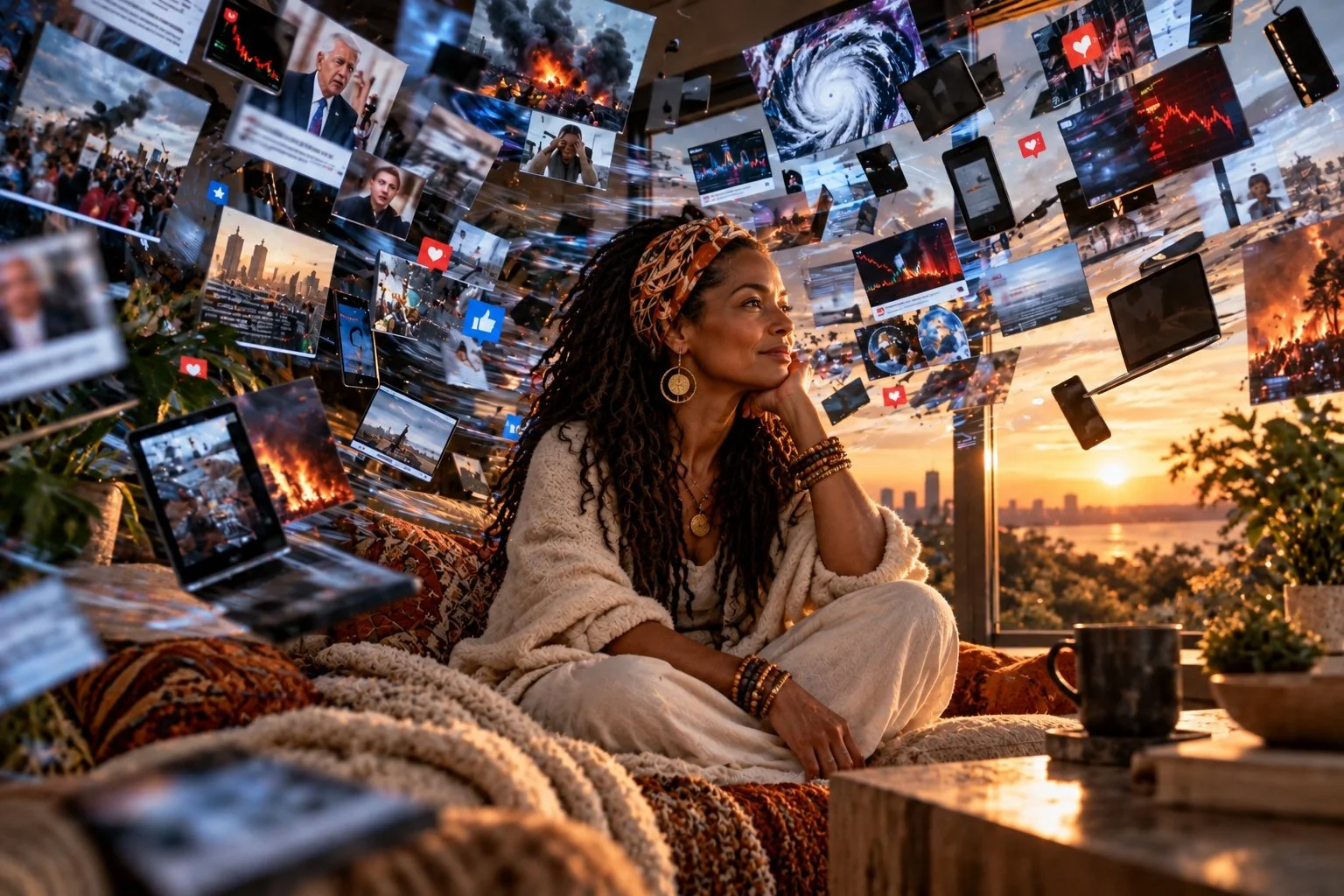
The World Is Fighting for Your Reaction. You Don't Have to Give It One.
Something happens somewhere in the world.
Within seconds, your phone knows.
Within minutes, millions of people are reacting.
Within hours, sides have formed.
Anger rises. Fear spreads. Opinions harden. People who knew absolutely nothing about the situation that morning are suddenly certain what everyone else should think about it by lunchtime.
And tomorrow?
Something else will take its place……
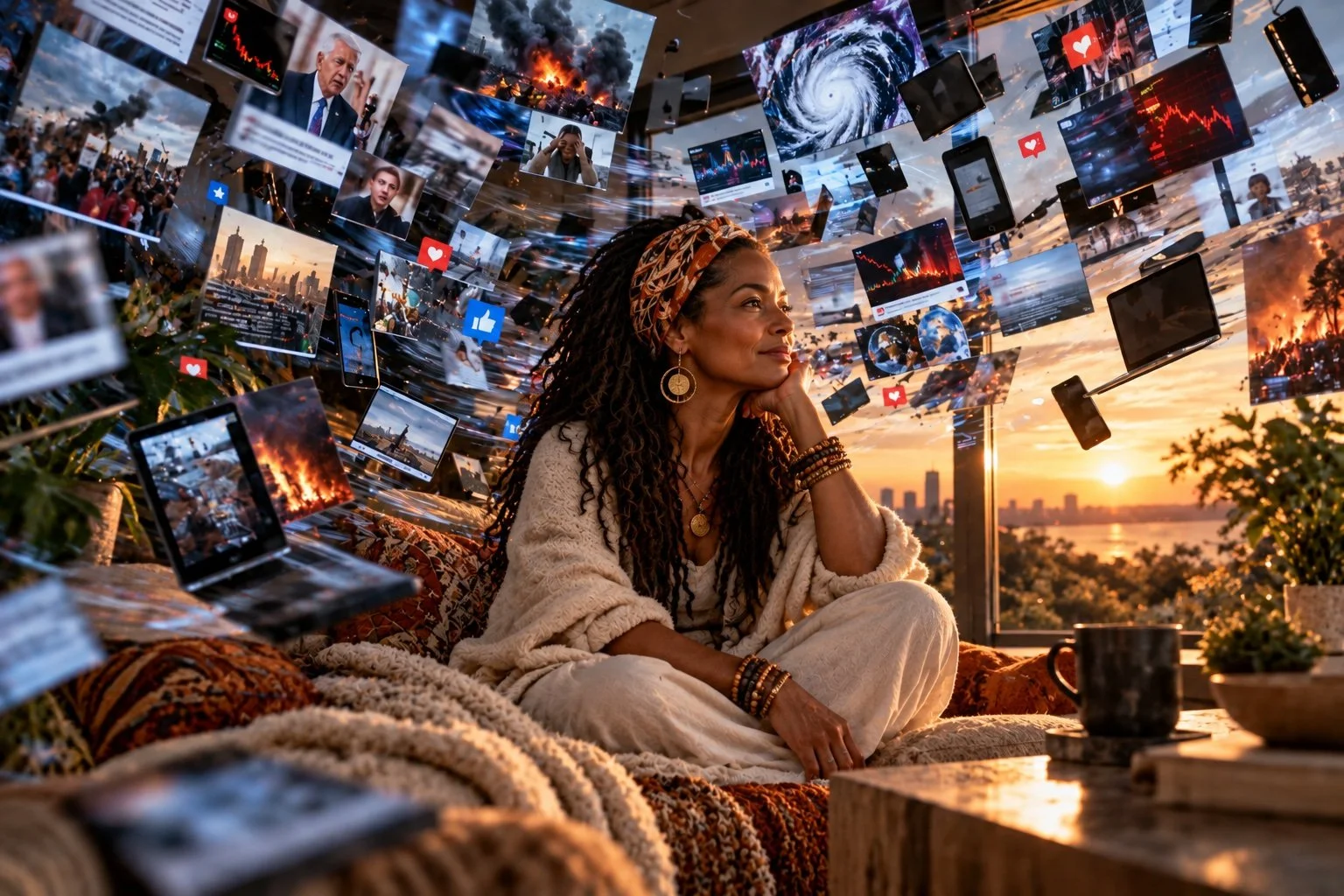
By Helena Collins and Brian Collins | Life in Synergy®
If this question has ever lived in your body, this article found you for a reason.
Something happens somewhere in the world.
Within seconds, your phone knows.
Within minutes, millions of people are reacting.
Within hours, sides have formed.
Anger rises. Fear spreads. Opinions harden. People who knew absolutely nothing about the situation that morning are suddenly certain what everyone else should think about it by lunchtime.
And tomorrow?
Something else will take its place.
Welcome to modern consciousness.
Never in human history have so many events, emotions, tragedies, opinions, advertisements, arguments, predictions and demands for our attention been able to enter our minds so quickly.
The world no longer knocks on the door.
It lives in our pocket.
And increasingly, it wants something from us.
A reaction.
Not necessarily understanding.
Not contemplation.
Not wisdom.
Reaction.
Click.
Respond.
Share.
Judge.
Fear.
Buy.
Condemn.
Defend.
Choose a side.
Do it quickly.
Because there is another piece of information coming right behind it.
And perhaps one of the most radical things a human being can do today is something remarkably simple.
Not react immediately.
There is a difference between being informed and being internally invaded.
That distinction matters.
We can care deeply about what happens in the world without allowing every event in the world to determine what happens inside of us.
But that requires something modern life does not particularly encourage.
Stillness.
Because stillness creates space.
And space gives us the opportunity to recognize a pattern before becoming part of it.
Think about how quickly emotion can travel now.
Someone posts something angry.
Another person sees it and becomes angry.
They carry that anger into another conversation.
Maybe they snap at their spouse.
Their spouse becomes defensive.
The atmosphere in the house changes.
A child senses it.
Nobody in that home has ever met the person who created the original post.
Yet their emotional energy has traveled through a screen and entered a completely unrelated room.
We often think of human patterns as enormous things—childhood experiences, relationships, family dynamics, generational behavior.
But patterns can also happen in seconds.
Stimulus. Reaction. Reinforcement. Repeat.
Something happens.
We feel something.
We react.
The reaction temporarily releases the feeling.
The brain remembers.
And the next time the trigger appears, the pathway becomes a little easier to travel.
Eventually we stop experiencing the reaction as a choice.
We begin experiencing it as who we are.
"That's just how I am."
Maybe.
Or maybe that's simply how you've reacted enough times that the reaction now feels like identity.
Those are not necessarily the same thing.
At Life in Synergy®, we spend a great deal of time looking at recurring patterns because transformation becomes extraordinarily difficult when we mistake a pattern for ourselves.
If I believe I am angry, there appears to be very little room between me and anger.
But if I can recognize I am experiencing anger, something changes.
There is suddenly an observer.
There is space.
And inside that space lives choice.
This doesn't mean suppressing emotion.
Quite the opposite.
Anger can contain information.
Fear can contain information.
Sadness can contain information.
Frustration can contain information.
Even jealousy, resentment and defensiveness can tell us something about what is happening within us.
But information and instruction are different things.
An emotion can inform you without being allowed to command you.
That distinction may be one of the most important forms of personal freedom available to us.
Because if every external stimulus can automatically determine our internal response, then who exactly is running our life?
Consider something much smaller than world events.
Your spouse says something.
Instant reaction.
A coworker sends an email.
Instant reaction.
Someone doesn't return your call.
Reaction.
A stranger looks at you strangely.
Reaction.
Someone disagrees with something you believe.
Reaction.
You see something online that challenges your worldview.
Reaction.
Before long, we can spend an entire day having our emotional state operated by people who may have absolutely no idea they are operating it.
That is exhausting.
And it is one of the reasons taking responsibility for 100% of your 50% matters so much.
Your 50% does not mean controlling what happens.
It means becoming responsible for what you bring to what happens.
Someone else's behavior belongs to them.
Your response belongs to you.
Someone else's anger belongs to them.
What you do with the energy that reaches you belongs to you.
Someone else's opinion belongs to them.
Whether you allow it to destabilize your sense of self belongs to you.
That doesn't mean we become emotionless statues sitting peacefully while the world burns around us.
It means we stop confusing consciousness with passivity.
A conscious response can be powerful.
It can establish a boundary.
It can say no.
It can leave.
It can intervene.
It can challenge injustice.
It can speak loudly.
It can protect someone.
It can change something.
But there is a profound difference between action born from awareness and reaction born from unconsciousness.
One chooses.
The other fires.
And our world has become extraordinarily good at making us fire.
There is money in your reaction.
There is attention in your reaction.
There is engagement in your reaction.
There is influence in your reaction.
There is power in keeping human beings emotionally activated.
Which makes your inner peace incredibly valuable territory.
Protect it.
Not by hiding from the world.
By learning how to stand inside yourself while participating in it.
Before responding, pause.
Before sharing, understand.
Before judging, become curious.
Before assuming intention, ask whether you actually know it.
Before carrying someone's anger into another room, ask yourself whether it belongs there.
Before allowing today's headline to consume today's life, look around.
You are here.
This moment is here.
Perhaps someone you love is sitting ten feet away.
Perhaps sunlight is entering the window.
Perhaps your dog wants to go outside.
Perhaps dinner is cooking.
Perhaps nothing in the physical room you are standing in resembles the chaos currently occurring on the screen in your hand.
That doesn't mean the suffering elsewhere isn't real.
It means this moment is real too.
And we should be careful not to sacrifice every peaceful moment we actually possess to every frightening possibility that exists somewhere else.
There is an old human pattern hiding here.
We believe vigilance will protect us.
If I worry enough, perhaps I'll be prepared.
If I stay informed enough, perhaps nothing will surprise me.
If I anticipate every possible danger, perhaps I'll finally feel safe.
But eventually vigilance can become another form of fear.
And fear has an enormous appetite.
It is rarely satisfied by one more headline.
So perhaps the question isn't whether we should stop paying attention to the world.
We shouldn't.
The question is:
Can we pay attention without surrendering ourselves to everything we see?
Can we witness suffering and remain compassionate without becoming consumed?
Can we disagree without becoming hatred?
Can we encounter fear without allowing fear to become our identity?
Can we receive information without immediately turning it into reaction?
Can we remain human in a world increasingly designed to turn human attention into a commodity?
That may be one of the great consciousness challenges of our time.
And no government, technology, algorithm or artificial intelligence can do that work for us.
Because the final decision still occurs somewhere extraordinarily private.
Inside you.
There is a moment—sometimes only a fraction of a second—between what reaches you and what you send back into the world.
That tiny space may not look particularly impressive.
There are no fireworks.
No headlines.
No applause.
But inside that space lives something enormous.
Free will.
Something enters you.
And instead of automatically passing it along, you examine it.
Is this mine?
Is this true?
Is this helpful?
Is this fear?
Is this an old pattern?
Is this asking for a response—or simply trying to provoke one?
And then you choose.
Maybe you respond.
Maybe you act.
Maybe you speak.
Maybe you walk away.
Maybe you turn off the phone.
Maybe you go sit beside the person you love.
Maybe you step outside and remember that the world is larger than the screen telling you what the world is.
That isn't ignorance.
That is consciousness.
The world will continue competing for your reaction.
Tomorrow there will be another headline.
Another argument.
Another prediction.
Another crisis.
Another person absolutely certain that you should be terrified, furious or outraged immediately.
You don't have to become numb.
You don't have to stop caring.
You don't have to stop participating.
Just remember something extraordinarily important:
Your attention belongs to you.
Your reaction belongs to you.
Your inner peace belongs to you.
And before you hand any of them over, you are allowed to ask whether what is standing in front of you deserves them.
Sometimes the most powerful response available to a human being is not reacting faster.
It is becoming conscious enough to choose what happens next.
If This Article Found You...
If you have been feeling overwhelmed by the sheer amount of information, conflict, anger and uncertainty entering your life, perhaps the answer isn't to become better at absorbing all of it.
Perhaps it is time to become more conscious of what you allow to remain inside you.
Ask yourself:
What has been controlling my reactions lately?
Then go deeper.
Is this response coming from the present moment—or from a pattern I have carried into it?
The Apex Life in Synergy® Program was created to help people recognize recurring life patterns, explore subconscious influences and understand the internal mechanisms that can quietly shape our relationships, reactions and choices.
You cannot control everything that enters the world.
You can become increasingly conscious of what leaves you and enters it.
That is your 50%.
Own 100% of it.
Recognize the pattern.
Create the space.
Choose consciously.
Return to One.
Life in Synergy®, founded by Helena Collins and Brian Collins, is dedicated to helping individuals understand recurring life patterns, cultivate inner peace, and develop higher levels of consciousness through multi-award-winning online educational programs. The Apex Life in Synergy® Program, Synergistics Fitness Method®, EFV Keys, and Helena Collins' bestselling Nutritional Alignment® integrate spiritual wellness, behavioral insight, subconscious awareness, and practical personal transformation into one comprehensive educational system.