
Ohm’s Law and the Spirituality of Resistance: When the Energy Within Us Meets the Forces Around Us
At first glance, it seems like a subject better suited for an electrical engineer than someone exploring consciousness, personal transformation, or the deeper meaning of life.But sometimes the greatest insights are hiding in the simplest principles.
And sometimes science offers us a metaphor so profound that it invites us to look at ourselves, our relationships, and the invisible influences shaping our lives in an entirely different way. What if the energy we spend trying to become more powerful would be better spent understanding what prevents us from expressing the power we already possess?

By Helena and Brian Collins | Life in Synergy®
If this question has ever lived in your body, this article found you for a reason.
There is a fascinating principle in physics called Ohm’s Law. It describes something remarkably simple: the relationship between electrical potential, the flow of current, and resistance.
At first glance, it seems like a subject better suited for an electrical engineer than someone exploring consciousness, personal transformation, or the deeper meaning of life.But sometimes the greatest insights are hiding in the simplest principles.
And sometimes science offers us a metaphor so profound that it invites us to look at ourselves, our relationships, and the invisible influences shaping our lives in an entirely different way. What if the energy we spend trying to become more powerful would be better spent understanding what prevents us from expressing the power we already possess?
What if resistance, rather than a lack of potential, is one of the greatest obstacles to living a Life in Synergy?
The Invisible Relationship Between Energy and Resistance
Ohm’s Law establishes that electrical current is determined by voltage divided by resistance.
In simple terms, when voltage remains constant, increasing resistance reduces the flow of current.
Now imagine this principle as a metaphor for human consciousness.
Consider voltage as the potential within you. The capacity to create, to love, to understand, to transform, and to evolve.
Consider current as the expression of that potential through your thoughts, emotions, decisions, relationships, and actions.
And consider resistance as everything that interferes with your ability to express yourself authentically.
Fear. Doubt. Resentment. Conditioning. Unresolved experiences. Expectations. The need for approval. The belief that you must become something other than who you are before you deserve to experience peace.
Suddenly, a principle of electricity becomes an invitation to examine the human experience.
We spend enormous amounts of energy trying to increase our potential without considering the resistance through which that potential must travel.
We seek more motivation, more knowledge, more affirmation, more spiritual experiences, and more reassurance that we are moving in the right direction.
Yet the question remains:
What happens when the resistance within our lives continues to increase while we keep demanding more energy from ourselves?
Eventually, something begins to feel strained.
Not necessarily because our potential has diminished, but because the relationship between our potential and our resistance has become increasingly difficult to navigate.
Not All Resistance Begins Within Us
This is where the conversation becomes particularly interesting.
We often hear that our limitations are entirely self-created. That every obstacle originates in our thinking, and that changing our thoughts will somehow change everything around us.
There is value in recognizing our responsibility for our internal world.
But there is also a difference between taking responsibility for our lives and assuming responsibility for every influence that enters them.
Human beings do not develop in isolation.
From our earliest experiences, we are exposed to ideas about who we should become, what we should believe, how we should behave, and which parts of ourselves are acceptable.
Some of these influences provide guidance, protection, and wisdom.
Others, however, can gradually introduce resistance into a life that once moved with a much greater sense of freedom.
A repeated suggestion can become a belief.
A judgment can become self-doubt.
An expectation can become an obligation.
And an obligation, repeated often enough, can begin to feel like an unquestionable part of our identity.
Sometimes the most influential limitations are not those imposed through obvious force.
They are the ones we eventually learn to impose upon ourselves without remembering where they originated.
We begin questioning our instincts, dismissing our perceptions, and seeking permission to trust what we already know about our own experiences.
And perhaps the most remarkable aspect of this process is how quietly it can happen.
A person may spend years attempting to overcome an internal obstacle without realizing that part of the obstacle was introduced through the expectations, fears, or beliefs of someone else.
This is not about blaming others for the direction of our lives.
It is about developing the awareness necessary to distinguish between what genuinely belongs to us and what we have unconsciously accepted along the way.
Taking responsibility for your life does not require accepting someone else's interpretation of who you are.
When Resistance Becomes Familiar
There is something curious about the human relationship with discomfort.
We can become so accustomed to resistance that its absence feels unfamiliar.
Someone who has spent years anticipating criticism may find themselves uncomfortable when nobody is criticizing them.
Someone who has learned to associate love with obligation may feel uneasy when affection is offered freely.
Someone who has repeatedly been told to question their own judgment may struggle to make a decision without consulting another person.
The resistance has become familiar.
And familiarity, even when uncomfortable, can be mistaken for safety.
This is one reason recurring patterns can be so difficult to recognize.
We may believe we are responding to the circumstances directly in front of us when, in fact, we are responding through the accumulated influence of experiences that occurred long before.
The past has become an invisible participant in the present.
Yet familiarity does not make a pattern permanent.
Awareness gives us the opportunity to examine the beliefs and responses we have carried, determine whether they continue to serve us, and consciously choose something different.
That is where transformation begins.
The Spiritual Significance of Energy, Frequency, and Vibration
Throughout history, spiritual traditions have explored the concept of a vital force expressed through life.
Chi in Chinese philosophy. Prana in Indian traditions. Ki in Japanese thought. Mana in Polynesian traditions.
Although these concepts emerge from different cultural and philosophical understandings, each invites contemplation of the relationship between life, vitality, and the unseen dimensions of human experience.
Within Life in Synergy®, we explore Energy, Frequency, and Vibration through our EFV Keys teachings as a framework for greater awareness and personal alignment.
Ohm’s Law offers an intriguing analogy for this exploration.
Electrical energy behaves according to measurable physical principles. Human consciousness, however, involves biological, psychological, emotional, and experiential processes that cannot simply be reduced to an electrical equation.
The connection is metaphorical, but the reflection can be powerful.
If we consider our personal energy as the capacity to engage with life, then the patterns we repeatedly express influence how that capacity is experienced.
Thoughts influence emotions.
Emotions can influence behavior.
Behavior shapes relationships.
Relationships influence our environment.
And our environment can reinforce the very patterns through which we interpret ourselves.
The cycle continues until awareness introduces a different possibility.
The objective is not to eliminate every uncomfortable thought or emotion.
It is to recognize when a familiar pattern is directing our behavior without our conscious participation.
Awareness is the moment we recognize that a pattern exists. Conscious choice is the moment we begin changing our relationship with it.
The Difference Between Resistance and Resonance
There is another concept worth exploring: resonance.
In physics, resonance occurs when a system responds strongly to stimulation at or near one of its natural frequencies.
Spiritually, we can borrow the idea as a metaphor for alignment.
Think about the moments when your thoughts, feelings, intentions, and actions seem to move together rather than compete against one another.
You are not struggling to convince yourself of something you do not believe.
You are not exhausting yourself attempting to maintain an identity that feels foreign.
You are not constantly adjusting your inner world to satisfy the expectations of everyone around you.
There is a sense of coherence.
A sense that your actions reflect your understanding.
That your choices reflect your values.
That your life is becoming a more authentic expression of who you are.
This is what we mean when we speak about living in synergy.
Not a life without challenges.
Not a life without disagreement.
And certainly not a life in which every circumstance bends to our desires.
Rather, a life in which we become increasingly conscious of how we participate in our own experiences.
The difference between resistance and resonance, in this spiritual analogy, is not simply whether life feels easy or difficult.
It is whether we are acting from awareness or repeatedly reacting through conditioning.
The Heat We Generate When We Fight Ourselves
Electrical resistance can produce heat.
And while emotional stress is not governed by Ohm’s Law, the comparison raises an interesting question.
How much of our daily exhaustion comes from the internal struggle between what we genuinely feel and what we believe we are supposed to feel?
Consider the energy required to maintain an appearance of happiness while experiencing sadness.
To agree outwardly while disagreeing inwardly.
To continually explain ourselves to people who have already decided what they believe about us.
To suppress an intuition because acknowledging it might require an uncomfortable decision.
These contradictions can become exhausting.
Over time, we may begin searching for relief without recognizing that the internal conflict itself deserves our attention.
We try to relax while continuing to participate in the very patterns that disturb our peace.
We seek clarity while repeatedly dismissing our own observations.
We search for freedom while remaining attached to the approval of those who may never understand our choices.
Perhaps the solution is not always to push harder.
Perhaps it begins with recognizing where our energy is being consumed.
And perhaps the most important question is not, "How do I become stronger?"
But rather:
"What am I continuing to carry that no longer belongs in the life I am choosing to create?"
Resistance Is Not Always the Enemy
Here is where we must be careful not to oversimplify the metaphor.
In an electrical system, resistance is not inherently negative. It can be essential for controlling current and allowing components to function safely.
The same distinction is valuable in human life.
Not every boundary is a blockage.
Not every disagreement is dysfunction.
Not every refusal represents fear.
Sometimes saying no is an expression of extraordinary clarity.
Sometimes questioning an accepted belief is the beginning of genuine understanding.
Sometimes the resistance we experience is not evidence that something within us needs to be corrected.
It may be a signal that something around us deserves closer examination.
Spiritual growth should never require abandoning discernment.
Nor should personal transformation become an endless exercise in accepting every outside judgment as a revelation about ourselves.
There is a profound difference between remaining open to learning and surrendering our capacity to think independently.
Healthy resistance protects our integrity.
Unconscious resistance can restrict our growth.
Learning to recognize the difference is an essential part of developing self-awareness.
Your 100% of Your 50%
At Life in Synergy®, one of our foundational teachings is the importance of giving 100% of your 50%.
This principle becomes especially meaningful when examining the relationship between personal energy and resistance.
In every relationship, interaction, and shared experience, there are elements within our responsibility and elements that belong to others.
We can take responsibility for our thoughts, actions, choices, and willingness to grow.
We cannot assume responsibility for another person's consciousness, behavior, or interpretation of reality.
When we attempt to control what belongs to someone else, we introduce unnecessary struggle into our lives.
When we allow others to define what belongs within our own responsibility, we can lose sight of our personal authority.
Giving 100% of your 50% is not about doing half the work.
It is about bringing your full awareness and integrity to the part of life that is genuinely yours.
It means recognizing that another person's opinion does not automatically become your truth.
It means understanding that compassion does not require self-abandonment.
And it means accepting that we can love, support, and understand others without surrendering responsibility for the direction of our own lives.
This is not selfishness.
It is conscious participation.
Becoming the Conscious Conductor of Your Life
For decades, Helena Collins has explored the relationship between physical awareness, personal transformation, and the patterns through which individuals experience their lives.
Her creation of the Synergistics Fitness Method® in 1996 reflects an important aspect of this philosophy: the value of becoming conscious of how we engage our bodies rather than simply moving through familiar motions.
That same principle extends beyond physical movement.
Within our Apex Life in Synergy® Program, Nutritional Alignment® teachings, and EFV Keys, we invite individuals to examine the relationship between their physical, emotional, mental, and spiritual experiences.
The intention is not to provide another rigid set of beliefs that people must adopt.
It is to encourage the awareness necessary to examine their existing beliefs for themselves.
Because genuine personal transformation cannot be reduced to following someone else's instructions indefinitely.
At some point, knowledge must become understanding.
Understanding must become awareness.
And awareness must become conscious participation in everyday life.
We are not suggesting that every challenge can be overcome simply by changing our thoughts. Life is far more complex than that.
But we are suggesting that recognizing our patterns, questioning inherited assumptions, and developing greater self-awareness can change how we respond to the circumstances we encounter.
And that can change the direction of a life.
The Power Was Never the Problem
Return for a moment to Ohm’s Law.
Imagine a circuit with tremendous electrical potential but substantial resistance.
Increasing the voltage may increase the current, but it does not necessarily address the underlying characteristics of the circuit.
Now consider how often we approach our own lives in a similar manner.
We demand greater effort.
Greater determination.
Greater discipline.
Greater spiritual commitment.
We convince ourselves that if we could only become more powerful, more enlightened, or more deserving, everything would finally fall into place.
Yet sometimes the more meaningful work is not about adding something new.
It is about examining what has accumulated.
The assumptions we never questioned.
The expectations we never consciously accepted.
The emotional patterns we continue to repeat.
The beliefs that quietly influence our decisions.
And the subtle ways we may have learned to measure ourselves through someone else's understanding of our worth.
We do not need to reject every influence or challenge every relationship to reclaim our personal authority.
We need to become aware enough to recognize which influences encourage our growth and which ones repeatedly lead us away from our own understanding.
You do not have to fight every current that moves through your life. But you do have the right to determine which direction you choose to travel.
Perhaps that is one of the most beautiful lessons we can draw from this simple principle of physics.
Not that human consciousness is an electrical circuit.
Not that spiritual evolution can be calculated with a mathematical equation.
But that potential, expression, and resistance are worthy of our attention.
And sometimes, in the pursuit of becoming something greater, we discover that the most meaningful transformation begins by questioning what has been standing between us and the authentic expression of who we already are.
That is the journey toward a Life in Synergy.
And it begins with awareness.
If This Article Found You...
Perhaps there is something in your life that has required more effort than it should.
Perhaps you have been trying to change a familiar pattern without understanding why it continues to return.
Or perhaps you have begun questioning whether some of the limitations you have accepted truly originated within you.
You do not need to answer every question today.
Begin by observing.
Notice when you feel aligned with your choices and when you feel compelled to abandon them.
Notice the difference between guidance that expands your understanding and influence that diminishes your confidence in your own judgment.
And remember that personal responsibility does not mean carrying everything that has ever been placed upon you.
At Life in Synergy®, our multi-award-winning educational programs, including the Apex Life in Synergy® Program, Synergistics Fitness Method®, EFV Keys, and Nutritional Alignment®, offer opportunities to explore greater self-awareness, personal growth, and a more conscious relationship with everyday life.
Because the journey is not about becoming who someone else believes you should be.
It is about discovering how to participate more consciously in the life that is yours to live.
I choose a Life in Synergy.
Discover more at www.lifeinsynergy.com.

The Synergistics Fitness Method® : The Method Helena Collins Builtin 1996 When Traditional Fitness Wasn't Enough
Why isn't my body working together?
That question sits at the heart of the Synergistics Fitness Method®.
Created by Helena Collins in 1996, the Synergistics Fitness Method® grew from an idea that was remarkably ahead of its time: instead of simply pushing the body harder, what if we taught the body to work more intelligently as an interconnected whole?
Long before wellness became an algorithm, before social media turned exercise into entertainment, and before “mind-body connection,” functional movement, and integrated wellness became everyday industry language, Helena was working directly with people and observing what their bodies were actually doing.
Real bodies.
Real limitations.
Real imbalances.
Real pain.
And real frustration…..
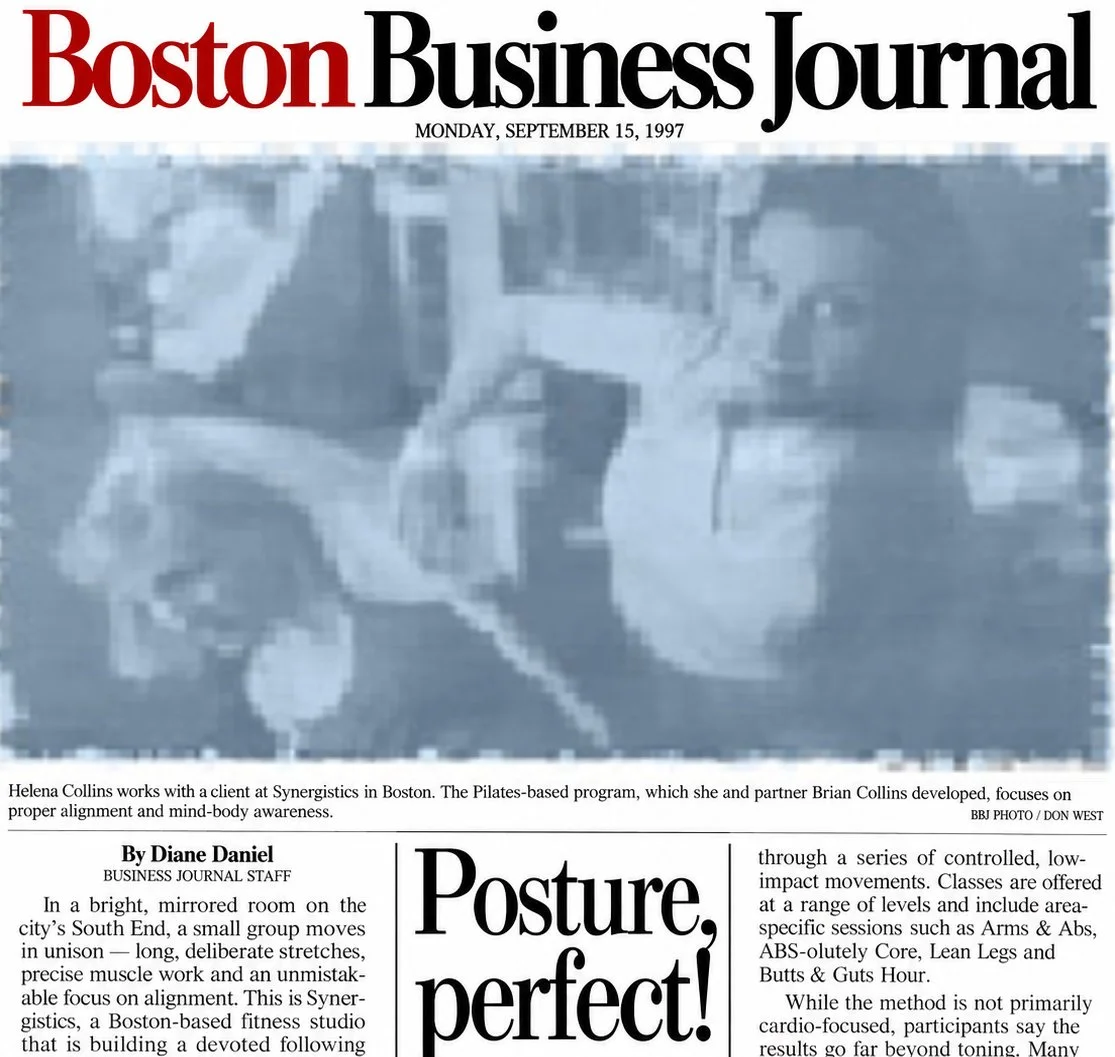
By Helena Collins, Creator of the Synergistics Fitness Method® and Apex Life in Synergy® Program
If this question has ever lived in your body, this article found you for a reason.
There comes a point when you have to stop asking your body to work harder and start asking a much more intelligent question:
Why isn't my body working together?
That question sits at the heart of the Synergistics Fitness Method®.
Created by Helena Collins in 1996, the Synergistics Fitness Method® grew from an idea that was remarkably ahead of its time: instead of simply pushing the body harder, what if we taught the body to work more intelligently as an interconnected whole?
Long before wellness became an algorithm, before social media turned exercise into entertainment, and before “mind-body connection,” functional movement, and integrated wellness became everyday industry language, Helena was working directly with people and observing what their bodies were actually doing.
Real bodies.
Real limitations.
Real imbalances.
Real pain.
And real frustration.
Helena saw something that would ultimately change the direction of her work.
People were exercising, sometimes relentlessly, but exercising more wasn't necessarily creating better bodies.
Strong muscles were getting stronger.
Dominant muscles were continuing to dominate.
Underutilized muscles could remain largely asleep.
Movement patterns were being repeated simply because people had been taught that repetition, intensity, sweat and suffering were evidence of an effective workout.
Helena began questioning the entire equation.
What if the answer wasn't working harder?
What if the answer was learning to work intelligently?
In 1996, Helena turned those observations into what became the Synergistics Fitness Method®—her own proprietary approach to movement, muscular balance and conscious physical awareness.
Helena Collins Didn't Set Out to Create Another Fitness Trend
SFM wasn't born in a corporate conference room.
It wasn't created to capitalize on whatever workout happened to be fashionable that year.
It was created by Helena Collins in 1996, through her own experience with the body and her observations of how people moved, compensated, strengthened and struggled.
Helena had experienced the frustration herself: working out intensely while dealing with physical issues and not getting the intelligent, balanced result she wanted.
Instead of accepting that as normal, she started investigating.
Why were certain muscles constantly doing the work?
Why did other muscles seem almost disconnected from movement?
Why could someone appear physically strong while still lacking balance or stability?
Why were people repeatedly hammering the same muscles while barely communicating with others?
And perhaps most importantly:
Why were we treating the human body like a collection of unrelated parts instead of one interconnected system?
Helena's answer was Synergistics.
Not isolation for isolation's sake.
Integration.
What Is the Synergistics Fitness Method®?
The Synergistics Fitness Method® (SFM), created by Helena Collins in 1996, is a proprietary low-impact movement methodology designed to help create greater muscular balance by consciously engaging underutilized muscles, addressing overused areas, improving stabilization and developing greater awareness of how the body actually moves.
It uses controlled, precise movement rather than mindless repetition.
That distinction matters.
Because SFM isn't simply concerned with whether you can complete an exercise.
It asks:
What is actually doing the exercise?
That's an entirely different conversation with the body.
If the strongest muscle continually takes over a movement, simply performing more repetitions can reinforce the imbalance you're trying to correct.
SFM brings awareness into that equation.
Movement becomes something you experience rather than merely execute.
You begin noticing where tension originates.
Which muscles immediately take control.
Which muscles aren't participating.
Where stability disappears.
Where compensation occurs.
Where movement feels restricted.
And eventually something rather beautiful happens.
You stop merely exercising your body.
You begin learning its language.
No, SFM Is Not Pilates
Let's clear this one up.
The Synergistics Fitness Method® is not Pilates.
Over the years, some journalists compared aspects of SFM's controlled, precise movements with Pilates because they needed an existing fitness vocabulary through which to describe something unfamiliar.
The comparison is understandable.
But the distinction matters.
Helena developed SFM as her own methodology.
Its philosophy, sequencing, muscular emphasis and larger concept of physical synergy came from Helena's observations, experience and work with clients.
SFM wasn't created by asking:
How can we make another version of Pilates?
It emerged from a completely different question:
How can we teach the entire body to work more intelligently together?
That question became the foundation.
The Forgotten Muscles
Here's where SFM becomes fascinating.
Most people naturally gravitate toward movements they perform well.
And the body is incredibly clever.
Give it a task and it will find a way to accomplish it.
Unfortunately, accomplishing the movement doesn't necessarily mean accomplishing it optimally.
Dominant muscles can compensate for weaker ones.
One side of the body can quietly work harder than the other.
Large muscle groups can overpower smaller stabilizing muscles.
And because the movement still happens, we assume everything is fine.
SFM challenges that assumption.
Sometimes the muscle that needs the most attention is precisely the muscle you've barely noticed.
That is why Helena's method became known for deliberately working areas that traditional routines often overlooked.
The movements can sometimes appear deceptively small.
Then you actually do them.
And suddenly some little muscle you apparently haven't spoken to since the Clinton administration introduces itself rather loudly.
Hello. I've been here the whole damn time.
That moment is pure SFM.
Because awareness has arrived.
Small Movement Doesn't Mean Small Work
Modern fitness has trained people to associate effectiveness with spectacle.
Sweat harder.
Jump higher.
Lift heavier.
Move faster.
Collapse dramatically onto the floor afterward so everyone knows something important happened.
SFM takes another path.
A movement doesn't need to be enormous to create meaningful muscular engagement.
Sometimes reducing the movement actually makes cheating more difficult.
Momentum disappears.
Compensation becomes easier to recognize.
Attention increases.
The participant has to remain present.
And presence changes exercise.
You're no longer simply counting repetitions.
You're feeling where the movement originates.
That is the difference between moving your body and understanding your body.
Workout Smart, Not Hard
One of the principles associated with Helena's work from the early days was beautifully simple:
Workout smart, not hard.
That didn't mean SFM was easy.
Anyone who actually experienced one of Helena's classes in Boston could probably have a good laugh at that suggestion.
Smart doesn't mean effortless.
Smart means purposeful.
Every movement should have a reason.
Every position should have intention.
Every repetition should communicate something to the body.
The goal isn't punishment.
The goal is progress.
And there's an enormous difference between the two.
Before Wellness Became a Buzzword
The Synergistics Fitness Method® was created in 1996, long before today's explosion of integrated wellness language and long before many of the concepts now common in the wellness industry became fashionable.
Helena and Brian Collins operated their Life in Synergy studios in Boston, where Helena taught SFM to thousands of people over decades.
The method developed a devoted following because people weren't merely being instructed to exercise.
They were being taught to pay attention.
To their posture.
Their movement.
Their breathing.
Their strength.
Their limitations.
Their patterns.
Their bodies.
And Helena began recognizing something even larger.
The patterns people demonstrated physically often didn't exist in isolation.
Human beings compensate.
We compensate physically.
We compensate emotionally.
We compensate behaviorally.
We compensate in relationships.
We compensate when we're afraid.
We compensate when we don't believe we're strong enough.
And sometimes we compensate for so long that the compensation begins feeling normal.
Sound familiar?
That realization would eventually help Helena's work expand far beyond physical fitness.
The Body Was Teaching a Bigger Lesson
This is where the history of SFM connects directly with what Life in Synergy® has become today.
The body provided Helena with a laboratory for understanding human patterns.
A person might unconsciously allow one muscle to dominate a movement while another barely participates.
Look closely enough at human behavior and something remarkably similar can happen emotionally.
One person overfunctions.
Another withdraws.
One partner carries everything.
Another avoids responsibility.
One part of ourselves becomes enormously developed while another remains neglected.
Different arena.
Same underlying principle:
Imbalance eventually asks to be corrected.
The body taught Helena something profound.
Awareness changes patterns.
And that realization became part of the larger foundation from which the Apex Life in Synergy® Program would eventually grow.
From Physical Alignment to Life Alignment
Today, Helena's work reaches beyond exercise.
But SFM remains an important piece of the architecture.
The Synergistics Fitness Method® teaches awareness through the physical body.
Nutritional Alignment® brings consciousness into our relationship with nourishment.
The Apex Life in Synergy® Program examines the subconscious and behavioral patterns shaping our experiences.
Brian Collins's EFV Keys explores our relationship with energetic frequency and conscious response.
Different doors.
Same house.
Awareness.
Because transformation becomes extraordinarily difficult when we cannot perceive the pattern creating the imbalance.
Whether we're talking about a neglected muscle or a repeating emotional relationship, awareness gives us the opportunity to choose differently.
Your Body Isn't Your Enemy
Perhaps one of the most important ideas behind Helena's work is that the body doesn't need to be conquered.
It needs to be understood.
For generations, fitness culture taught people to fight themselves.
Burn the fat.
Destroy the workout.
Crush the weakness.
Punish the body for what you ate.
Push through everything.
SFM asks for something more sophisticated.
Listen.
What is your body actually telling you?
Where are you compensating?
Where are you disconnected?
Where are you stronger than necessary?
Where have you become weak because something else has always done the work?
Where are you holding?
Where are you avoiding?
And what changes when awareness enters those places?
That's not weakness.
That's intelligence.
The Real Meaning of Synergistics
The name tells you almost everything.
Synergy.
Parts working together in a way that creates something greater than those same parts operating independently.
That principle extends far beyond fitness.
Your muscles aren't separate from your posture.
Your posture isn't completely separate from your breathing.
Your breathing isn't completely separate from your emotional state.
Your emotional state influences your behavior.
Your behavior shapes your relationships.
Your relationships affect the life you experience.
Pull one thread and eventually you discover the tapestry.
That is the territory Life in Synergy has spent decades exploring.
SFM simply began the conversation through the body.
More Than a Workout
The Synergistics Fitness Method® deserves to be understood for what Helena Collins actually created in 1996.
Not simply as another exercise class.
Not as Pilates under another name.
Not as a collection of tiny movements.
And certainly not as a relic from an earlier fitness era.
SFM represents an idea that has become even more relevant today:
The human body functions best when its parts communicate, cooperate and operate consciously as a whole.
Strength without awareness can reinforce dysfunction.
Movement without attention can reinforce compensation.
Intensity without intelligence can simply make an existing pattern stronger.
But when awareness enters movement, something changes.
You begin noticing.
Then understanding.
Then adjusting.
And eventually—
aligning.
That journey from unconscious repetition to conscious alignment became much bigger than fitness for Helena Collins.
It became a philosophy for living.
And three decades after Helena first created the Synergistics Fitness Method® in 1996, perhaps the most important lesson of SFM isn't about abs, glutes, shoulders or thighs at all.
It is this:
What we don't consciously engage, we unconsciously compensate for.
In the body.
In relationships.
In our emotional lives.
And sometimes across an entire lifetime.
The body was simply the first teacher.
Helena listened.
And in 1996, the Synergistics Fitness Method® was born.
If This Article Found You...
Perhaps you've spent years trying to force your body—or your life—into submission.
Maybe the next chapter isn't about pushing harder.
Maybe it's about becoming aware enough to finally understand what has been doing all the work, what has been neglected, and what is asking to come back into balance.
That is where Synergistics begins.
And sometimes, that is where an entirely different relationship with yourself begins too.
Life in Synergy®, founded by Helena Collins and Brian Collins, is dedicated to helping individuals understand recurring life patterns, cultivate inner peace, and develop higher levels of consciousness through multi-award-winning online educational programs. The Apex Life in Synergy® Program, Synergistics Fitness Method®, EFV Keys, and Helena Collins' Nutritional Alignment® integrate physical awareness, spiritual wellness, behavioral insight, subconscious awareness and practical personal transformation into one comprehensive educational system.
Discover more at Life in Synergy®.

The Price at the Pump Is Rising. So Is the Pressure Inside Us.
You pull into the gas station.
You get out of the car, insert the card, grab the nozzle and watch the numbers begin climbing.
$20.
$40.
$60.
$80.
And somewhere between the first gallon and the last, something else starts rising too.
Your frustration.
Your fear.
Maybe your anger.

By Helena Collins & Brian Collins, Founders of Life in Synergy®
If this question has ever lived in your body, this article found you for a reason.
You pull into the gas station.
You get out of the car, insert the card, grab the nozzle and watch the numbers begin climbing.
$20.
$40.
$60.
$80.
And somewhere between the first gallon and the last, something else starts rising too.
Your frustration.
Your fear.
Maybe your anger.
Gasoline has become more than fuel. For millions of people, the number glowing above that pump has become another reminder that life feels increasingly expensive, increasingly uncertain and increasingly outside their control.
And right now, that feeling isn't imaginary.
On September 30, 2026, AAA's national average for regular gasoline stood at approximately $4.43 per gallon, compared with roughly $3.15 one year earlier. The U.S. Energy Information Administration's latest weekly figure similarly put regular gasoline at $4.465 per gallon.
But at Life in Synergy®, we want to ask a different question.
What happens inside human beings when the world outside them becomes increasingly unstable?
Because perhaps the most important thing happening at the gas pump isn't occurring inside your gas tank at all.
It is happening inside you.
External Pressure Reveals Internal Pressure
Let's be very clear about something.
Human emotions do not magically determine the price of gasoline.
Gas prices are influenced by very real economic and geopolitical forces: crude-oil prices, production, supply, demand, refining, distribution and international events. Recent elevated prices have been associated in part with expensive crude oil and continuing volatility surrounding the Strait of Hormuz.
But those forces exist within a human civilization.
And civilization is ultimately the accumulated behavior of human beings.
Fear.
Competition.
Territorialism.
Scarcity.
Power.
Consumption.
Control.
Conflict.
These aren't merely geopolitical concepts. They are human patterns.
The same unresolved patterns that can destroy a marriage, fracture a family or poison a workplace can appear on a vastly larger stage between communities, institutions and nations.
The scale changes.
The underlying human tendencies often don't.
That is where the conversation becomes fascinating.
Humanity Keeps Trying to Fix the Outside
We have become extraordinarily sophisticated at rearranging the external world.
We move resources.
We build pipelines.
We negotiate agreements.
We impose sanctions.
We create markets.
We develop technologies.
We elect governments.
We fight wars.
We negotiate peace.
Then another crisis appears and we rearrange everything again.
Yet comparatively little attention is given to the consciousness of the human beings making all these decisions.
We keep trying to engineer a peaceful world while frequently carrying conflict within ourselves.
We demand cooperation from nations while struggling to cooperate with our spouse.
We condemn greed in institutions while privately believing there will never be enough for us.
We demand honesty from leaders while avoiding uncomfortable truths within ourselves.
We complain about humanity's divisions while carrying unresolved resentment toward the person sitting across from us at dinner.
That contradiction matters.
Because the world doesn't exist separately from the people creating it.
We are the world.
The Gas Pump Becomes a Trigger
Now watch what happens psychologically when gasoline climbs.
The pump doesn't simply say:
$4.43 per gallon.
Your subconscious may hear something entirely different.
Things are getting worse.
I'm losing control.
What happens next?
How much will groceries cost?
Can we afford this?
Who's responsible for this?
And suddenly a financial event becomes an emotional event.
Fear searches for certainty.
Anger searches for someone to blame.
Anxiety searches for the next threat.
And before long, people aren't responding only to the price of gasoline anymore.
They're responding to every unresolved fear that price awakened.
This is how external instability can amplify internal instability.
Your 100% of Your 50%
One of the principles we teach through the Apex Life in Synergy® Program is deceptively simple:
You are responsible for 100% of your 50%.
You cannot personally control global oil markets.
You cannot single-handedly end international conflict.
You cannot determine what a barrel of crude oil costs tomorrow morning.
That isn't your 50%.
But you absolutely have responsibility for what happens inside you when circumstances outside you change.
That is your 50%.
Do you immediately enter fear?
Do you become angry?
Do you begin catastrophizing?
Do you carry that frustration home?
Do you snap at your partner?
Do you transfer financial anxiety onto your children?
Do you spend the evening doomscrolling through increasingly frightening predictions?
Or can you recognize the trigger before becoming the reaction?
That moment of awareness is where personal transformation begins.
The Real Energy Crisis
Perhaps humanity is experiencing more than one energy crisis.
There is the energy we extract from beneath the earth.
And there is the energy we continuously generate inside ourselves.
Fear is energy.
Anger is energy.
Resentment is energy.
Compassion is energy.
Gratitude is energy.
Love is energy.
Awareness is energy.
Every human interaction transfers something.
Imagine billions of people walking around carrying unresolved fear, resentment, trauma and scarcity consciousness—and then bringing those energies into marriages, workplaces, boardrooms, governments and international negotiations.
Why would we expect the collective world to remain peaceful when the individuals creating that world are often anything but peaceful inside themselves?
This doesn't mean meditation will suddenly lower gasoline prices.
It means something much more challenging:
A more peaceful civilization ultimately requires more peaceful human beings.
What If the Pump Became a Teacher?
The next time you watch those numbers spinning upward, observe yourself.
Not the price.
You.
Notice what arises.
Fear?
Anger?
Scarcity?
Helplessness?
Blame?
Then ask:
Where have I felt this before?
Because chances are, the gas pump didn't create that emotion.
It revealed it.
This is precisely the territory we explore through Life in Synergy®, the Apex Life in Synergy® Program, EFV Keys, Nutritional Alignment® and the Synergistics Fitness Method®.
Different doors.
Same human being walking through them.
We teach people to recognize recurring patterns rather than spending an entire lifetime unconsciously reenacting them.
Because when you understand the pattern, something remarkable happens.
You gain choice.
And choice changes energy.
Humanity's Outer World Is Telling Us Something
Perhaps our greatest mistake is believing every crisis exists exclusively outside ourselves.
The expensive gas.
The political division.
The wars.
The environmental strain.
The loneliness.
The anger.
The endless feeling that humanity is standing on some enormous psychological fault line.
We keep asking:
What's wrong with the world?
Maybe another question belongs beside it:
What remains unresolved within the people creating the world?
That doesn't eliminate the need for economics, diplomacy, policy, technology or practical solutions.
Quite the opposite.
It asks something more of the people responsible for creating those solutions.
Awareness.
Responsibility.
Emotional maturity.
And the ability to recognize when fear is driving the vehicle.
Because humanity has spent centuries attempting to rearrange the world around the unresolved human being.
Perhaps it's time we worked on the human being too.
The next revolution may not begin in an oil field.
It may begin quietly, inside millions of people who finally realize that peace is not something humanity can continually demand from the world while refusing to cultivate it within ourselves.
And maybe the next time you're standing at the pump watching those numbers climb, instead of allowing fear to take the wheel, you can remember:
The price of gasoline may be outside your control.
The energy you carry away from that pump is not.
If This Article Found You...
If something in these words made you uncomfortable, curious or strangely seen, don't rush past it.
Follow it.
The recurring reactions in our lives are rarely random. They can be invitations to understand something deeper about ourselves.
At Life in Synergy®, we help people recognize the patterns operating beneath their reactions and learn how to take responsibility for 100% of their 50%—not because we can control everything happening around us, but because transformation begins with what we actually can change.
Return to One.
Life in Synergy®, founded by Helena Collins and Brian Collins, is dedicated to helping individuals understand recurring life patterns, cultivate inner peace, and develop higher levels of consciousness through multi-award-winning online educational programs. The Apex Life in Synergy® Program, Synergistics Fitness Method®, EFV Keys, and Helena Collins' bestselling Nutritional Alignment® integrate spiritual wellness, behavioral insight, subconscious awareness, and practical personal transformation into one comprehensive educational system.

The World Is Fighting for Your Reaction. You Don't Have to Give It One.
Something happens somewhere in the world.
Within seconds, your phone knows.
Within minutes, millions of people are reacting.
Within hours, sides have formed.
Anger rises. Fear spreads. Opinions harden. People who knew absolutely nothing about the situation that morning are suddenly certain what everyone else should think about it by lunchtime.
And tomorrow?
Something else will take its place……

By Helena Collins and Brian Collins | Life in Synergy®
If this question has ever lived in your body, this article found you for a reason.
Something happens somewhere in the world.
Within seconds, your phone knows.
Within minutes, millions of people are reacting.
Within hours, sides have formed.
Anger rises. Fear spreads. Opinions harden. People who knew absolutely nothing about the situation that morning are suddenly certain what everyone else should think about it by lunchtime.
And tomorrow?
Something else will take its place.
Welcome to modern consciousness.
Never in human history have so many events, emotions, tragedies, opinions, advertisements, arguments, predictions and demands for our attention been able to enter our minds so quickly.
The world no longer knocks on the door.
It lives in our pocket.
And increasingly, it wants something from us.
A reaction.
Not necessarily understanding.
Not contemplation.
Not wisdom.
Reaction.
Click.
Respond.
Share.
Judge.
Fear.
Buy.
Condemn.
Defend.
Choose a side.
Do it quickly.
Because there is another piece of information coming right behind it.
And perhaps one of the most radical things a human being can do today is something remarkably simple.
Not react immediately.
There is a difference between being informed and being internally invaded.
That distinction matters.
We can care deeply about what happens in the world without allowing every event in the world to determine what happens inside of us.
But that requires something modern life does not particularly encourage.
Stillness.
Because stillness creates space.
And space gives us the opportunity to recognize a pattern before becoming part of it.
Think about how quickly emotion can travel now.
Someone posts something angry.
Another person sees it and becomes angry.
They carry that anger into another conversation.
Maybe they snap at their spouse.
Their spouse becomes defensive.
The atmosphere in the house changes.
A child senses it.
Nobody in that home has ever met the person who created the original post.
Yet their emotional energy has traveled through a screen and entered a completely unrelated room.
We often think of human patterns as enormous things—childhood experiences, relationships, family dynamics, generational behavior.
But patterns can also happen in seconds.
Stimulus. Reaction. Reinforcement. Repeat.
Something happens.
We feel something.
We react.
The reaction temporarily releases the feeling.
The brain remembers.
And the next time the trigger appears, the pathway becomes a little easier to travel.
Eventually we stop experiencing the reaction as a choice.
We begin experiencing it as who we are.
"That's just how I am."
Maybe.
Or maybe that's simply how you've reacted enough times that the reaction now feels like identity.
Those are not necessarily the same thing.
At Life in Synergy®, we spend a great deal of time looking at recurring patterns because transformation becomes extraordinarily difficult when we mistake a pattern for ourselves.
If I believe I am angry, there appears to be very little room between me and anger.
But if I can recognize I am experiencing anger, something changes.
There is suddenly an observer.
There is space.
And inside that space lives choice.
This doesn't mean suppressing emotion.
Quite the opposite.
Anger can contain information.
Fear can contain information.
Sadness can contain information.
Frustration can contain information.
Even jealousy, resentment and defensiveness can tell us something about what is happening within us.
But information and instruction are different things.
An emotion can inform you without being allowed to command you.
That distinction may be one of the most important forms of personal freedom available to us.
Because if every external stimulus can automatically determine our internal response, then who exactly is running our life?
Consider something much smaller than world events.
Your spouse says something.
Instant reaction.
A coworker sends an email.
Instant reaction.
Someone doesn't return your call.
Reaction.
A stranger looks at you strangely.
Reaction.
Someone disagrees with something you believe.
Reaction.
You see something online that challenges your worldview.
Reaction.
Before long, we can spend an entire day having our emotional state operated by people who may have absolutely no idea they are operating it.
That is exhausting.
And it is one of the reasons taking responsibility for 100% of your 50% matters so much.
Your 50% does not mean controlling what happens.
It means becoming responsible for what you bring to what happens.
Someone else's behavior belongs to them.
Your response belongs to you.
Someone else's anger belongs to them.
What you do with the energy that reaches you belongs to you.
Someone else's opinion belongs to them.
Whether you allow it to destabilize your sense of self belongs to you.
That doesn't mean we become emotionless statues sitting peacefully while the world burns around us.
It means we stop confusing consciousness with passivity.
A conscious response can be powerful.
It can establish a boundary.
It can say no.
It can leave.
It can intervene.
It can challenge injustice.
It can speak loudly.
It can protect someone.
It can change something.
But there is a profound difference between action born from awareness and reaction born from unconsciousness.
One chooses.
The other fires.
And our world has become extraordinarily good at making us fire.
There is money in your reaction.
There is attention in your reaction.
There is engagement in your reaction.
There is influence in your reaction.
There is power in keeping human beings emotionally activated.
Which makes your inner peace incredibly valuable territory.
Protect it.
Not by hiding from the world.
By learning how to stand inside yourself while participating in it.
Before responding, pause.
Before sharing, understand.
Before judging, become curious.
Before assuming intention, ask whether you actually know it.
Before carrying someone's anger into another room, ask yourself whether it belongs there.
Before allowing today's headline to consume today's life, look around.
You are here.
This moment is here.
Perhaps someone you love is sitting ten feet away.
Perhaps sunlight is entering the window.
Perhaps your dog wants to go outside.
Perhaps dinner is cooking.
Perhaps nothing in the physical room you are standing in resembles the chaos currently occurring on the screen in your hand.
That doesn't mean the suffering elsewhere isn't real.
It means this moment is real too.
And we should be careful not to sacrifice every peaceful moment we actually possess to every frightening possibility that exists somewhere else.
There is an old human pattern hiding here.
We believe vigilance will protect us.
If I worry enough, perhaps I'll be prepared.
If I stay informed enough, perhaps nothing will surprise me.
If I anticipate every possible danger, perhaps I'll finally feel safe.
But eventually vigilance can become another form of fear.
And fear has an enormous appetite.
It is rarely satisfied by one more headline.
So perhaps the question isn't whether we should stop paying attention to the world.
We shouldn't.
The question is:
Can we pay attention without surrendering ourselves to everything we see?
Can we witness suffering and remain compassionate without becoming consumed?
Can we disagree without becoming hatred?
Can we encounter fear without allowing fear to become our identity?
Can we receive information without immediately turning it into reaction?
Can we remain human in a world increasingly designed to turn human attention into a commodity?
That may be one of the great consciousness challenges of our time.
And no government, technology, algorithm or artificial intelligence can do that work for us.
Because the final decision still occurs somewhere extraordinarily private.
Inside you.
There is a moment—sometimes only a fraction of a second—between what reaches you and what you send back into the world.
That tiny space may not look particularly impressive.
There are no fireworks.
No headlines.
No applause.
But inside that space lives something enormous.
Free will.
Something enters you.
And instead of automatically passing it along, you examine it.
Is this mine?
Is this true?
Is this helpful?
Is this fear?
Is this an old pattern?
Is this asking for a response—or simply trying to provoke one?
And then you choose.
Maybe you respond.
Maybe you act.
Maybe you speak.
Maybe you walk away.
Maybe you turn off the phone.
Maybe you go sit beside the person you love.
Maybe you step outside and remember that the world is larger than the screen telling you what the world is.
That isn't ignorance.
That is consciousness.
The world will continue competing for your reaction.
Tomorrow there will be another headline.
Another argument.
Another prediction.
Another crisis.
Another person absolutely certain that you should be terrified, furious or outraged immediately.
You don't have to become numb.
You don't have to stop caring.
You don't have to stop participating.
Just remember something extraordinarily important:
Your attention belongs to you.
Your reaction belongs to you.
Your inner peace belongs to you.
And before you hand any of them over, you are allowed to ask whether what is standing in front of you deserves them.
Sometimes the most powerful response available to a human being is not reacting faster.
It is becoming conscious enough to choose what happens next.
If This Article Found You...
If you have been feeling overwhelmed by the sheer amount of information, conflict, anger and uncertainty entering your life, perhaps the answer isn't to become better at absorbing all of it.
Perhaps it is time to become more conscious of what you allow to remain inside you.
Ask yourself:
What has been controlling my reactions lately?
Then go deeper.
Is this response coming from the present moment—or from a pattern I have carried into it?
The Apex Life in Synergy® Program was created to help people recognize recurring life patterns, explore subconscious influences and understand the internal mechanisms that can quietly shape our relationships, reactions and choices.
You cannot control everything that enters the world.
You can become increasingly conscious of what leaves you and enters it.
That is your 50%.
Own 100% of it.
Recognize the pattern.
Create the space.
Choose consciously.
Return to One.
Life in Synergy®, founded by Helena Collins and Brian Collins, is dedicated to helping individuals understand recurring life patterns, cultivate inner peace, and develop higher levels of consciousness through multi-award-winning online educational programs. The Apex Life in Synergy® Program, Synergistics Fitness Method®, EFV Keys, and Helena Collins' bestselling Nutritional Alignment® integrate spiritual wellness, behavioral insight, subconscious awareness, and practical personal transformation into one comprehensive educational system.

What Remains After the Door Slams? The Energy We Leave Behind
A slammed door ends a moment, but not its energetic impact. Discover how emotional energy, unresolved patterns, and conscious awareness shape every relationship.

If this question has ever lived in your body, this article found you for a reason.
By Helena Collins, creator of the Apex Life in Synergy® Program
A door slams.
The sound lasts only a second. The physical movement is over almost as soon as it begins. Yet the moment itself may remain suspended in the room, in the body, and between two people long after the door has stopped moving.
One person stands on one side, perhaps shaking, furious, frightened, or suddenly numb. The other walks away, convinced that the interaction has ended. But has it?
At Life in Synergy®, we understand human interaction as more than the exchange of words and visible gestures. Every encounter also carries intention, emotion, attention, and energy. A door slammed in someone’s face is therefore not merely an object being closed. It can become a declaration without language: You are shut out. You do not matter. Your presence is unwanted. I refuse to meet you here.
The person closing the door may not consciously mean all of those things. They may simply be overwhelmed and desperate to escape an interaction. But human beings do not receive one another through intention alone. We also receive impact. The space between what one person intended and what the other person experienced is where many repeating patterns begin.
The body hears the slam
Before the conscious mind has time to explain the event, the body may respond. The shoulders tighten. The jaw locks. Breathing becomes shallow. The heart seems to strike harder against the chest. A person may freeze in place or immediately feel the urge to shout, cry, retaliate, or disappear.
This physical response does not prove weakness or overreaction. The body is responding to sudden sound, motion, conflict, and perceived rejection. It is attempting to determine whether the moment is over or whether something else is coming.
For the person who slammed the door, the body is also involved. Anger does not evaporate merely because a barrier has been placed between two people. The hand that pushed the door may still be tense. The breath may remain shortened. The mind may begin constructing a case for why the action was justified. Beneath that mental argument, however, the body can remain caught inside the unfinished encounter.
This is one reason dramatic exits rarely deliver the freedom they promise. They create distance, but distance is not necessarily resolution. The room changes; the inner state often does not.
The etheric echo of an unfinished moment
Within the spiritual framework of Life in Synergy®, we use the word etheric to describe a subtle energetic dimension of human experience. This is not presented as a medical measurement. It is a way of understanding the felt atmosphere carried by intention, emotion, and unresolved interaction.
Most people have experienced this dimension whether or not they use spiritual language for it. You enter a room after an argument and immediately sense that something happened. A person says, “I’m fine,” yet the space around them feels anything but fine. Someone leaves, but their anger appears to remain behind like heat in the air.
When a door is slammed in another person’s face, the etheric exchange can feel abrupt and violent because the relationship has been severed in motion but not completed in consciousness. The physical door closes; the energetic interaction remains open.
The rejected person may carry the moment forward as humiliation, abandonment, anger, or self-doubt. The person who slammed the door may carry it as righteousness, guilt, fear, or the temporary intoxication of control. Each person may leave with a different story, but both have been altered by the exchange.
If neither person becomes conscious of what happened, the energy seeks another place to go. It may appear later as coldness at dinner, impatience with a child, tension in the neck, sleepless mental rehearsals, or an argument about something apparently unrelated. Unprocessed energy is rarely loyal to its original location. It travels.
This does not mean every uncomfortable feeling is a mystical force, nor does it mean one difficult moment permanently damages an etheric field. It means that what we refuse to meet consciously can continue shaping perception, behavior, and the atmosphere of a relationship.
A boundary and a punishment are not the same thing
There are moments when closing a door is necessary. If an interaction is unsafe, abusive, threatening, or escalating beyond control, creating physical distance may be the wisest and most loving choice available. Spiritual responsibility never requires someone to remain accessible to harm.
But there is a profound difference between closing a door to establish safety and slamming it to inflict pain.
A conscious boundary says, “I cannot continue this interaction right now. I am stepping away.” A punitive gesture says, “I want you to feel my rejection.” Outwardly, the actions may look similar. Energetically, they are not.
The difference lives in intention, awareness, and what happens next. Does the person return when calm and take responsibility for their part? Do they explain the boundary? Do they acknowledge the impact? Or is silence used as a weapon, leaving the other person to wander inside uncertainty?
At Life in Synergy®, we teach that each person is 100% responsible for their 50% of an interaction. This does not mean accepting blame for another person’s behavior. It means refusing to abandon responsibility for the energy, choices, and patterns that belong to us. If you slammed the door, my responsibility is not erased because you were difficult. Consciousness begins when both people stop using the other person’s behavior as permission to remain unconscious.
The pattern beneath the hand
The door is rarely the whole story.
For one person, the slam may be an old pattern of power: When I feel vulnerable, I end the encounter before you can leave me. For another, it may be a pattern of emotional disappearance: When conflict awakens discomfort, I remove myself without explanation. For the person left outside, it may awaken an older wound: Once again, I am the one who is excluded, unheard, or abandoned.
These patterns can meet with extraordinary precision. One person fears being controlled and pushes away. The other fears abandonment and pursues. The pursuit intensifies the first person’s need to escape; the escape intensifies the second person’s need to pursue. Soon, neither is responding only to the present moment. Each is reacting from a history that has entered the room wearing today’s clothes.
This is why simply declaring who was right is often insufficient. Rightness may settle an argument, but it does not necessarily reveal the pattern. The deeper question is not only, “Who slammed the door?” It is, “What became activated in each of us before the door ever moved?”
Returning consciousness to the threshold
Healing does not require pretending the moment was harmless. It asks us to return to the threshold with greater awareness than we possessed when we left it.
Begin with the body. Before composing the perfect apology or defense, stop. Feel your feet. Release the jaw. Allow the exhalation to lengthen naturally. Notice whether the body is preparing to fight a battle that is no longer physically happening. A Return to One practice can help interrupt the momentum—not to suppress anger, but to prevent anger from becoming the only intelligence available.
Then name the act without decoration.
“I slammed the door in your face.”
Not, “I’m sorry, but you made me.” Not, “I only did it because you always...” The moment we attach an accusation to an apology, we quietly return responsibility to the other person.
The next step is to acknowledge impact without insisting that your intention be accepted as the final truth.
“I was overwhelmed and wanted the interaction to stop. I can see that the way I ended it may have felt rejecting and frightening.”
This language does not require self-condemnation. Shame often produces more hiding, more defensiveness, and another slammed door. Responsibility is different. Responsibility stands in the doorway and remains present.
If you were the person left on the other side, your work is equally sacred but different. You are allowed to name what happened. You are allowed to decide what behavior you will not accept. You are also invited to notice what the moment awakened within you. Did the event hurt only because of what happened today, or did it find an older doorway inside you—one that has been slammed many times before?
Recognizing an older wound does not excuse the present behavior. It prevents the present behavior from owning your entire history.
What we leave behind can be changed
No one moves through a lifetime without closing something too quickly. We have all withdrawn, reacted, protected, punished, or mistaken emotional force for personal power. Conscious living is not a performance of perfection. It is the willingness to become aware of the energy we create and to participate in its transformation.
The true aftereffect of a slammed door is not determined only by the slam. It is also determined by what follows.
Does pride guard the threshold? Does silence harden around the event? Do both people continue feeding the story until the moment becomes evidence for every injury they have ever known?
Or does someone become conscious enough to return—not necessarily to reopen the relationship, but to reopen integrity?
An apology can change the energy. A clearly spoken boundary can change it. An honest acknowledgment can change it. Sometimes the most powerful transformation occurs privately, when a person realizes, “I will no longer send my unresolved pain through doors, voices, bodies, or silence.”
That decision matters because energy does not end with the person directly in front of us. The aggression we do not examine can reach the next conversation. The rejection we do not heal can shape the next relationship. The tension held in the body can become the emotional weather of a home.
But consciousness travels too.
One person who stops, breathes, and refuses to pass the wound onward changes the field of what happens next. One person who becomes 100% responsible for their 50% creates a new possibility where repetition once seemed inevitable.
The door may already have slammed.
You cannot retrieve that second from time. But you can decide what energy will cross the next threshold.
If you are ready to understand the recurring patterns beneath your reactions and relationships, explore the Apex Life in Synergy® Program at LifeInSynergy.com. The work is not about becoming someone who never feels anger. It is about becoming conscious enough that anger no longer decides what you leave behind.
Life in Synergy®, founded by Helena Collins and Brian Collins, is dedicated to helping individuals understand recurring life patterns, cultivate inner peace, and develop higher levels of consciousness through multi-award-winning online educational programs. The Apex Life in Synergy® Program, Synergistics Fitness Method®, EFV Keys, and Helena Collins' bestselling Nutritional Alignment® integrate spiritual wellness, behavioral insight, subconscious awareness, and practical personal transformation into one comprehensive educational system. Discover more at https://www.lifeinsynergy.com.